Features>>Feng
Shui and Stair Cases
Feng
Shui and Stair Cases

Ms.
Li has been reading about Feng Shui, she asks me if it is true
when stairs run in line with the main door, it causes money
loss. Many people ask about this and I always tell them that
this is not necessarily true.
| |
First,
we must understand what a staircase is before we can know
how |
it
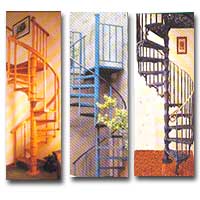
affects us. Staircases are made up of many steps, each protruding
out as a potential source of danger. When we are not careful,
it is easy to stumble or hurt ourselves on the steps. Staircases
are also vertical shafts that penetrate through each floor, making
a "hole" in the building, especially in high rises. In Feng Shui,
staircases are known as a source of sha chi or potentially harmful
or degenerating energy. Therefore, in order to understand what
effect it has on us, we must know the residents' birth elements
and where the staircase is located. Different people and different
stair locations have different effects
 When
the stair's mouth lines up with the front door, the influence
it has on the residents is not necessarily money loss. For instance,
if the resident is born under the dui or the metal element and
their door opens to the west - the stair's sha chi placed in
this direction may cause this person to have respiratory problems
or love affairs because the lungs and adultery are associated
with the dui or western metal frequencies (from the Yi-Jing
or Book of Changes
If
the stair aligns with a door that opens to the south or fire
energies, its negative energies conflict with the fire frequencies.
The resident may likely suffer circulatory problems because
the heart is associated with the south and fire. However, if
the person involved exercises daily and maintains good health,
they may not suffer these problems at all. Apparently, looking
only at the staircase is not enough to make a logical conclusion.
| |
In
Feng Shui, the house is analogous to the body. Having a
staircase at |
the
center or "heart" of the house is like having a hole pierced or
knife stuck in your heart. The residents may feel stressed living
in this type of environment. However, this stress may not affect
every house member in the same way.
| |
For
someone who is born under the wood element sleeping in the |
northwest
room, the staircase in the middle of the house may cause them
to have headaches or get tired easily. This is because the wood
frequency is associated with the liver energies while the northwest
is associated with the metal element and the head energies. When
these energies are interrupted, they do not function normally.
Abnormal liver energies cause one to be prone to temper, stuffiness
and quick exhaustion. With or without the staircase in the center,
there is already a tendency for headaches and easy exhaustion
when the two conflicting energies of wood and metal come together.
With the staircase's sha chi compounding the effect, the negativity
or symptoms may be worst.
| |
Likewise,
when the front of a staircase is aligned with a bedroom
door, |
the
effect it has on the person living in this room varies depending
on his or her birth element and the location of their bedroom.
For instance, a person born under the gen or northeast earth element
sleeping in the northeast room has a staircase directly in front
of her door. The staircase's negative energy interrupts this person's
gen related energies; resulting in arguments, back tension, low
energy or sinus allergies. If this same person had their bedroom
in the north, which is associated with the water element, having
the staircase's opening pointing straight into their room brings
a negative source of water frequencies that conflicts with the
person's gen or earth frequencies.
| |
When
earth energies encounter water energies, there is a higher
chance |
for
the person to commit adultery, suffer dizziness, back stress,
or nasal congestion. Again, these are potential effects; there
are other factors to consider before making an accurate conclusion
about how the house's Feng Shui actually influences a person's
well being.
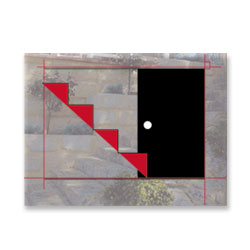 In
some apartments, there are staircases that cross right over
a door. As mentioned earlier, depending on the resident's birth
element and direction of the door, there are various possible
effects. If the door is opened to the east and the person living
inside is born under the Kan or water element, having the stair's
sha chi suppressing their door or eastern energies places stress
or interrupts the associated liver energies. The results of
weak liver energies are easy tiredness, emotional agitation,
and mugginess.
Because
the staircase is where people go up and down, the energies are
constantly moving. It is best to locate it on the left hand
or masculine side when one leaves the house. The masculine or
"dragon" side contains the energies that guard the constantly
changing or moving energies of family relationships, personal
activity and health. Placing the staircase, which is also an
active source of energy here, puts similar energies together
to enhance harmony.
| |
To
minimize the sha chi of the staircases, they should not
be straight; |
rather,
they should be curvaceously embracing the energy that comes in
from the front door. For safety, they should also be wide and
well lit.
| |
Therefore,
like Ms. Lee, we need to question "general" rules in Feng
|
Shui.
Because generalities are obviously not always true, they tend
to bring about skepticism towards Feng Shui. We must be careful
about what we read and hear in piecemeal. Like a jigsaw puzzle,
we need to put the pieces together to get a bigger picture that
better represents reality.
| |
For
those who have studied Feng Shui in depth understand that
there |
are
many levels of Feng Shui - few generalities can be made without
misleading people into thinking that the same rule applies to
everyone. We are all different and are affected differently by
our Feng Shui. The more factors taken into consideration, the
more detailed and accurate the Feng Shui analysis. Remember, staircases
are only ONE factor in Feng Shui and as you can see, there are
numerous variations and conditions to be considered. There are
60 factors involved in making an accurate conclusion about the
Feng Shui of your house and its effect on you.
 |
Jenny
T. Liu is a fourth generation practitioner who holds a BA
in Environmental Design from UC Berkeley and an MA in Architecture
from UCLA. Awarded for her Master's Thesis on Feng Shui,
she is an expert in the ancient Chinese philosophy of Feng
Shui. You may have seen her on Good Day LA, the LA Times
or local community papers. |
|