Two Women Who Changed the Course of China's History
Today is International Women's Day. Various sources quote this day as the "story of ordinary women as makers of history; it is rooted in the centuries-old struggle of women to participate in society on an equal footing with men."
In conjunction with this special day, Feng Shui Times takes a look at 2 extraordinary women who changed the course of China's history.
Tang Dynasty
(618-906 AD)
Empress Wu Zetian
Tang Dynasty - the height of culture, economics and politics in China's history. Artistic works soared and this includes paintings, poetry, calligraphy, pottery, books and such. It was the largest, richest and most sophisticated empire at that time. It's modernization steps were followed by other countries, and soon Chang'an became the center of cultural exchange between East and West.
The most glorious years of the Tang Dynasty were actually the achievement of Wu Zetian, a female empress who held the reins - tight. As to everything, there are two sides to her ruling. One, she was a ruthless and cruel autocrat in her desire to increase and maintain her power, and two she was the finest example any emperor could have followed.
Wu Zetian was born in during a time where the women in ancient China were able to contribute to politics and culture. Having the advantage to be born into a rich and noble family, Wu was taught to play music, write and read the Chinese classics. When she was 14 years old, her wit, intelligence and beauty led her to the courts of Emperor Taizong. Although at first a 5th grade concubine, she soon became his favorite concubine.
When Emperor Taizong passed away, his son Gaozong took over the throne. Wu soon won the emperor's favor and with some smart scheming, took over the place of the empress. When Emperor Gaozong became very ill, the Empress Wu took over the administrative duties of the court. The next emperor, her own son Li Xian was merely a puppet in her shadows.
In 705 AD, Wu was pressured to abdicate the throne in favor of her 3rd son. She passed away at the age 80 in December the same year.
Wu Zetian's standing achievements were as follow :
- Elevated the
social positions of women. For this, she had scholars write biographies of
famous women. She also tried to create a new ruling where women had more control
in court matters.
- A fair ruler
to under trodden societies. She lowered the peasants' taxes and helped raised
agricultural products, thus strengthening public works.
- Decreased the
powers of aristocratic military men by imposing a rule that everyone who wished
to serve the court had to pass the imperial examinations. This ensured that
the court was led by a group of educated people.
- Advanced literary
achievements by commissioning scholars to edit several classical texts. She
also wrote two books.
- A pious Buddhist,
Chinese Buddhism flourished under her reign. Temples and caves sculptures
were built all over the country.
- Became the only woman monarch in the history of China.
Qing Dynasty
(1644 - 1911)
Empress Dowager Cixi
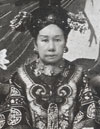 The
Empress Dowager Cixi was one of the most formidable women in the late 19th century.
Born on November 29 1835 to a middle-class family, Cixi (given name Yehonala
as the Qing Dynasty was formed by the Manchus - originally nomads from Manchuria,
northeast of China). When she was 17, she was chosen to enter the palace as
a concubine to Emperor Xianfeng (1831 - 1861). Soon she gave him a son and hence
was raised in rank from a 3rd grade concubine to a 1st grade. This position
is second only to the Empress herself.
Cixi had beauty and charms, as well as an inexhaustible desire for utmost power. Young, smart and skillful, she had 2 sides to her - either a great, sincere friend or the most terrible enemy. When Emperor Xianfeng passed away, her 5 years old son took the throne. A young kid governing the state affairs of China, you ask. In reality, it was Cixi who ruled. A bamboo screen was placed behind the young Tongzhi and from there, Cixi would tell him what to say and how to act.
When Tongzhi passed away, Cixi appointed her 3-year-old nephew, Guangxu as the emperor. Again, the young emperor was but a mere puppet to her dominance.
A conservative ruler, Cixi did not foresee the changes China was going through in the late 19th century. She disagreed with modernization, fearing that it would cause her to lose her power. This eventually led to the Boxer's Rebellion, where a group of people violently protested against foreigners in their land, and set to kill them all. When the allied foreigners (19 000 of them) retaliated and took over Beijing, Cixi ran to Xi'an with the emperor. She then had to sign a peace treaty, allowing foreigners a free stand in China, where they could also set up their bases.
After that incident which was the beginning of the end of the Qing Dynasty, Cixi opted in favor of modernization and social reforms. This was, however a little too late. In 1908, she suffered a stroke and realized that she was dying. Since she had imprisoned Guangxu, she decided to choose a new emperor. Three-year-old Pu Yi, her nephew was chosen and brought into the palace in the middle of the night.
However, the Empress Dowager Cixi passed away the next day at the age of 73. At this time, modern China was emerging. The slump in production and a rapidly growing populating caused the economy to drop. Financial resources were not substantial due to foreign expansion, and large-scale official corruption was common. Pressure from Japan and the West sparked off tension. Four years later Pu Yi was forced to abdicate the throne. Later, he was relegated to the ranks of an ordinary citizen of the Republic of China.
You may be thinking that what a terrible job Cixi did in running the country. It is in fact a matter of opinion; according to the laws of nature, what is up will go down, and vice versa. This woman, described as being on the short side, single-handed put into action most of the reforms every thought of by past Chinese statesmen.
And perhaps, the best way to summarize the empress dowager is a paragraph by Isaac Taylor Headland :
"The Empress
Dowager has no double in Chinese history, if indeed in the history of the world.
She not only guided the ship of state during the last half century, but she
guided it well, and put into operation all the greatest reforms that have ever
been thought of by Chinese statesmen. Compared with her own people, she stands
head and shoulders above any other woman of the Mongol race. And what shall
we say of her compared with the great women of other races? In strength of character
and ability she will certainly not suffer in any comparison that can be made.
We cannot, therefore, help admiring that young girl, who formerly ran errands
for her mother who, being made the concubine of an emperor, became the mother
of an emperor, the wife of an emperor, the maker of an emperor, the dethroner
of an emperor, and the ruler of China for nearly half a century - all this in
a land where woman has no standing or power. Is it too much to say that she
was the greatest woman of the last half century?"
-
Isaac Taylor Headland: Court Life in China: The Capital, Its Officials and
People, (New York, F.H. Revell, c1909)