Traditions Of Chinese New Year
The Lunar New Year, also known as Chinese New Year is the most celebrated festival in the Chinese festive calendar. This festival ushers in the new year and celebrations last for 15 days. Called 'Chun Jie' (Spring Festival) in Chinese, it was a symbol of renewed fertility of the earth in ancient China. Today it signifies a fresh beginning in life, a new start with new hopes for a prosperous new year - a year better than the last.
Before The New Year
Here are some rituals/activities done before the arrival of the New Year.
- Operation Massive
Cleaning
Every nook and corner of the home will be given a thorough cleaning. No dust or mess from the previous year should be carried forward, in view that this would drag past misfortunes to the new year. On the first day of Chinese New Year, brooms are hidden and no one should even think about sweeping the floor. This is so that incoming wealth luck will not be 'swept' away.
- Operation Debt-Collect
Old debts should be cleared to avoid shame and misfortune. New Year is one occasion where business people balance and settle their accounts.
- Operation Home
Decorating
Red, the ever popular color among the Chinese will be blatantly displayed in a home. Some even resort to painting their walls red in hope that the God of Prosperity will smile their way. Other popular decorations include pots of oranges, calligraphies, chrysanthemums, new cushion covers (preferably in red) - the list goes on. One very popular decoration is a piece of red paper inscribed with the word 'Fu' (Luck). This decoration can be seen in almost every household, especially with the paper hung upside down. This is done deliberately for those who hope for extra luck and fortune. The pronunciation for 'Fu Dao' (luck upside down) is similar to 'luck arrives'.
- Operation Everything-Is-New
New clothes, new sofa covers, new sheets, new appliances, new curtains, new houses…
- Operation Reunion
Dinner
Undoubtedly the most important feature of Chinese New Year, the reunion dinner is an occasion on Chinese New Year eve. It is an unspoken obligation to be present at the dinner. While some families keep it simple, many indulge in an elaborate feast, eating expensive and traditional food. The reunion dinner is a demonstration of family unity. It is believed that having eaten the reunion dinner, the family bond will be stronger.
On The Day Itself
Early in the morning, family members will usually pay respects to their ancestors if they have ancestral tablets in their homes. When the children wake up, they would receive 'ang pow' from their parents. 'Ang pows' are small red packets (red packet being the literal translation) that contain money. They can only be given to children and singles. Sometimes parents would place the 'ang pow' under their children's pillows, in hope that they would grow up strong and healthy.
Most Chinese would scrimp and save the whole year and spend a lot of money for the celebration of Chinese New Year. Hence they would deck themselves in bright new clothes and visit their relatives. A lot of snacks and sweet desert will be consumed while they sit around telling jokes and stories, basically having a good time among close friends and relatives.
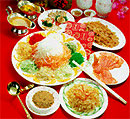 A
famous food, a must-have for Chinese New Year is the 'yee sang' (raw fish).
This salad basically contains thinly sliced raw fish (many prefer salmon), shredded
vegetables and tiny bits of crackers covered in a sweet, spicy and sour sauce.
Before starting the meal, everyone will toss the salad together, in the belief
of 'tossing up good fortune'.
Another popular food is the 'nian gao', meaning 'New Year cake'. This cake is made of rice flour and sugar, is brown in color, usually in a circular shape and very sticky. Traditional beliefs are that eating the cake will assist a person to attain a higher status and achieve better things in life. 'Nian gao' is also known as glutinous cake.
When people visit their friends and relatives during Chinese New Year, they would usually bring some mandarin oranges with them. These oranges will be given to the hosts, with auspicious greetings of 'Happy New Year' or 'Gong Xi Fatt Chai'. Before they leave, the hosts will give back their own supply of oranges. This is deemed an exchange of good luck.
Usually the first 2 days of Chinese New Year are reserved for families. The third and subsequent days will be left for visiting distant relatives and friends. Many shops are only opened on the third or fourth day. The fifth day is considered the birthday of the Money God, where people would pray and give offerings in hope for wealth luck. The seventh day of New Year is called 'everyone's birthday'. This is when families would gather and have another feast.
Dancing Lions
 Some
households or businesses would invite a lion dance troupe to their premises
during Chinese New Year. This is deemed auspicious as it is believed that the
lions will bring good luck and fortune to the household or business.
Far from real lions, the bodies of the 'lions' are made of cloth. Two dancers form the lion - one carrying the head and the other, bent down acts as the body. One must be fit, strong and well-taught to be able to perform this dance. Many lion dance troupes are from the local Chinese Associations.
If there is a Chinatown in your area, do not miss the chance to watch the lion dance during Chinese New Year.
Love Granted from the Moon and Sea
The final day of Chinese New Year is called 'Chap Goh Mei' or 'Yuan Xiao'. It is said that the God of Marriages from the moon is in his happiest mood, and hence the air is filled with romance. He would tie a magical and invisible red thread around the legs of newborns and singles to another person. When children grow up, the intended couple would be drawn together by a powerful bond. There will be a happy marriage if their paths cross.
On the night of 'Chap Goh Mei', it is said that the Goddess of the Sea is most eager to grant wishes. Singles would make their way to the river or sea with a handful or oranges. They would then throw the fruit into the dark waters while muttering their wishes for a good spouse. Some people would throw in other fruits such as litchee, red dates and even money, in hope for a good, fortunate life and wealth luck.
Feng Shui Times would like to wish all our readers a very Happy Chinese New Year. May you prosper in the Year of the Horse.