Eight House Theory And The Derivation Of The Stars
Eight House Theory is based on the Qing Dynasty book Ba Zhai Ming Jing, translated as Eight House Bright Mirror. This book is said to have been passed down from Yang, Yunsong, a thousand years ago. While this claim is unlikely, the Eight House system is quite popular in Asia and the West.
The major defect of the Eight House system is that time is not taken into account. However, it is a traditional compass school method. While it is not the pinnacle of compass feng shui, it is still important for us to have an understanding. In this essay we will look at the eight transformations of the trigrams and how the derived star received its portents.
1) How is it determined which trigrams belong to east group and which belong to west group?
(Pre-Heaven Order)
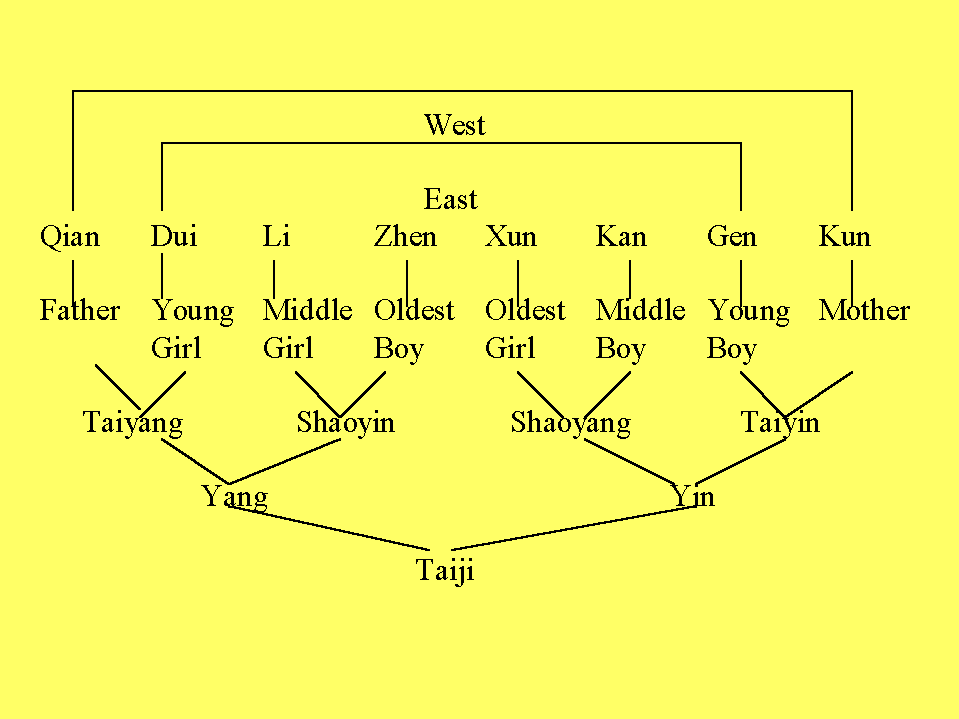
Kan, li, zhen, and xun are the east four houses. They are shao yang and shao yin. They are the center of the Fu Xi diagram, and also the middle members of the family, neither youngest nor oldest. The east group relates to water, wood, and fire, three elements in productive (sheng) order.
Qian, kun, dui, and gen are the four west houses. They are tai yang and tai yin. They are on the outside ends of the Fu Xi diagram and represent the oldest and the youngest family members. The west group corresponds to earth and metal, two elements in productive order.
- 2) What are
the eight variations or stars for each trigram?
- 2a) sheng qi
"vitality"; change the top line
2b) tian yi "celestial doctor"; change the bottom 2 lines
2c) yan nian "lengthened years (longevity)"; change all the lines
2d) fu wei "lying-down position"; no lines change
2e) huo hai "injury"; change the bottom line
2f) liu sha "six evils"; change the upper and lower lines
2g) wu gui "five ghosts"; change the upper two lines
2h) jue ming "exhausted fate"; change the center line
The focus of this essay is the line changing method, but there is also a mathematical method for calculating these eight changes by comparing pre-heaven and post-heaven positions. However, this alternative method is reserved for a separate essay.
3) How was it determined which change of lines is associated with which star?
There are two methods of determination, analysis by element and analysis by heaven, man, and earth lines.
- 3.1) Analysis
by element: This method will tell us why the first four are auspicious
and why the second four are inauspicious.
- The first four
changes are considered harmonious interactions. The paired trigram always
belongs to the same group (east or west) as the original, and the elements
are mostly in a productive relationship with each other.
3.1a) sheng qi; change the top line
The two west group pairs have the same element:
- qian metal / dui metal
- kun earth / gen earth
The two east group pairs have a productive (sheng) relationship:
- li fire/zhen wood
- kan water/xun wood
Since the same element reinforces and the productive relationship strengthens, sheng qi is strong and harmonious.
3.1b) tian yi; change the bottom 2 lines
All four pairs have a productive relationship:
- qian metal/gen earth
- kun earth/dui metal
- li fire/xun wood
- kan water/zhen wood
These are also strong and harmonious relationships.
3.1c) yan nian; change all lines
The west group pairs have a productive relationship:
- qian metal/kun earth
- gen earth/dui metal
One of the east group pairs has the same element:
- zhen wood/xun wood
Only fire (li) and water (kan) oppose each other. But this is the one domination (ke) that is fairly harmonious, just like the relationship of husband and wife, or heart (fire) and kidney (water) in Chinese medicine.
These are strong and harmonious relationships, but some tension has begun to creep in. Yan Nian is not quite as strong as sheng qi or tian yi.
3.1d) fu wei; no lines change
There is no change, so there is no disharmony. However, without movement and transformation this star is not very active.
- The second four
transformations are not harmonious. They result in a trigram of the opposite
group (east versus west), and often a domination (ke) relationship.
- 3.1e) huo
hai; change the bottom line
Two of the four groupings are productive:
- li fire/gen earth
- kan water/dui metal
The other two are domination:
- qian metal/xun wood
- kun earth/zhen wood
Even though there are two productive pairs, huo hai is inauspicious. Domination rules half of the pairs.
3.1f) liu sha; change the upper and lower lines
Two of the four groupings are productive:
- qian metal/kan water
- kun earth/li fire
The other two are domination:
- gen earth/zhen wood
- dui metal/xun wood
3.1g) wu gui; change the upper two lines
All four pairs have a domination relationship:
- qian metal/zhen wood
- kun earth/xun wood
- dui metal/li fire
- gen earth/kan water
3.1h) jue ming; change the center line
All four pairs have a domination relationship:
- qian metal/li fire
- kun earth/kan water
- dui metal/zhen wood
- gen earth/xun wood
The second four transformation have mostly inharmonious element relationships. All of these relationships are east group trigrams paired with west group trigrams. In this inauspicious group, the first (huo hai) is the least inauspicious, and the fourth (jue ming) is the most damaging transformation.
- 3.2) Analysis
by heaven, man, and earth lines: This method will give us more information
about the individual meanings of the eight stars. We will take the transformations
of qian as an example.
(The earth line is the lowest line of a trigram. The man line is the middle line. The heaven line is the upper line.)
- 3.2a) sheng
qi "vitality"; change the top line
Qian changes to dui. The upper line represents the youngest child. For example, dui is the youngest daughter because its only yin line is at the top. The youngest child will have the most vitality. The word for birth in Chinese is also sheng, as in 'sheng qi.' The youngest child will be the closest in the family to their birth. The Chinese text says this is an area where you can seek children (as well as wealth).
The upper line also represents heaven. Both heaven and qi (as in 'sheng qi') are considered yang. Sheng also means birth and growth, which is yang and moving up toward heaven.
Also remember from the above discussion that sheng qi pairs tend to have a productive or 'sheng' relationship with each other. So the name is also describing its element relationship.
3.2b) tian yi "celestial doctor"; change the bottom 2 lines
Qian changes to gen. Notice that we come to the youngest child once again.
Here, heaven is used to change man and earth luck. Since the heaven line remains stable, it is celestial help that is affecting a change in man on earth. This change is positive because the element relationships are productive.
The Chinese text says that this area is good for averting illness, as one might expect from the celestial doctor.
All pairs are sheng, or productive. Chinese medicine utilizes tonics which nourish to improve health. This is the elixir that produces the longevity of yan nian below:
3.2c) yan nian "lengthen years (longevity)"; all lines change
Qian changes to kun. Here, heaven, man, and earth lines all transform. Only 'old' lines change to their opposite. If all three lines change the trigram must be very old indeed. Hence, longevity.
In addition, when opposites meet and interact there can be inner alchemy, just as in tantric yoga or daoist longevity practices. You can easily see this idea represented by heaven and earth, fire and water.
Most pairs are also productive, which is beneficial. The only exception is fire (li) and water (kan). Yet these two are frequently used in the imagery of inner alchemy.
There is another way to look at this longevity. Often, in the pre-heaven order the trigrams are lined up and numbered 1 to 8. Qian is 1 and kun is 8. They are as far apart as can be and it takes a long time to travel from one end of the line to the other.
The Chinese text says that the area is good to fight illness and increase longevity.
3.2d) fu wei "lying-down position"; change no lines
Qian remains the same. This is called 'lying-down position' because it has no change. It is inactive and stable. It is always in the sitting or mountain section of the house.
We can also see an analogous image in Buddhism. Buddhist thought teaches that the four main experiences of suffering are birth, illness, old age, and death. Sheng qi is related to birth. Tian yi is related to illness. Yan Nian is related to old age. Death is possibly related to fu wei, as this is named 'lying-down position.'
Similarly, with feng shui, the energy of tian yi may be too strong for someone close to death. The patient may be better able to absorb the mild healing nutrients of fu wei.
- 3.2e) huo
hai "injury"; change the bottom line
Qian changes to xun. Here we are changing the earth level, the root. How well can a tree do if we undermine the root? It is injured.
Also think of the English saying, 'I felt like the rug was pulled out from under me.' This describes a life-shattering experience, and the huo hai change is a picture of this expression.
Two pairs dominate (ke), but two are productive (sheng). So there is injury but not death.
3.2f) liu sha "six evils"; change the upper and lower lines
Qian changes to kan. The man line remains, but heaven and earth are changing above and below him. Who can he trust? He is not grounded, nor can he rely on the help of heaven. The Chinese text mentions robbery. In this change the man level is robbed of everything around it.
Two pairs dominate (ke), but two are productive (sheng). So there is evil, but not death.
3.2g) wu gui "five ghosts"; change the upper two lines
Qian changes to zhen. Man changes state (becomes a ghost) and wanders in the heavens. Yet he remains tied to the earth.
All four pairs dominate, so there is death.
3.2h) jue ming "exhausted fate"; change the center line
Qian changes to li. Heaven and earth are stable, but man has changed to another state. From life to death. The heart is removed. The center is broken.
All four pairs dominate, so there is death.
- 4) Summary:
- 4a) East and
west trigrams are divided by element, position in the Fu Xi diagram, and by
a mathematical analysis of the relationship between the pre- and post-heaven
order. (Again, this third method is not described in this essay.)
4b) The trigram relationships are analyzed by which lines are changed. There are eight categories of change including sheng qi, tian yi, yan nian, fu wei, huo hai, liu sha, wu gui, and jue ming.
4c) The auspiciousness of a category is decided by the element relationship between the original trigrams and the changed trigrams. Four changes are auspicious and four are inauspicious. The auspicious changes remain in the same grouping (east or west). The inauspicious changes derive a trigram of the opposite group.
4d) The specific meaning of a change (beyond auspicious and inauspicious) can be seen by analyzing the lines by their position of heaven, man, and earth.