The Luo Shu, A Hidden Tai Ji?
The LUO SHU, a hidden TAI JI?
The
LUO SHU is also called the magic square. But
the greater magic lies within the Luo Shu.
Magic square because the numbers added up diagonal, horizontal or
vertical result always in 15. It is said that in ancient times a
turtle emerged from the river Luo with markings on its back resembling
these numbers given below.
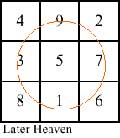
The arrangement of the numbers shown here is in the LATER HEAVEN SEQUENCE. As it has been arranged by King WEN.
|
Horizontal: | 4
+ 9 + 2 = 15 3 + 5 + 7 = 15 8 + 1 + 6 = 15 |
|||||||||||
| Vertical: | 4
+ 3 + 8 = 15 9 + 5 + 1 = 15 2 + 7 + 6 = 15 |
||||||||||||
| Diagonal: | 8
+ 5 + 2 = 15 4 + 5 + 6 = 15 |
||||||||||||
 Only
these numbers will not help us any further with our Feng Shui studies. But as
soon as we blend the TAI JI over the magic square we will come one step further.
The TAI JI is a two dimensional sign representing YIN and YANG. YIN and YANG
are the two opposing universal forces representing Qi. Always trying to reach
a situation of total harmony. There is always a waxing and waning. Please imagine
them not as a flat picture but as a sphere constantly in motion.
YIN
is the cold, female, dark, even numbers.
YANG is the hot, male, light, odd numbers.
The
black dot in the white area (YANG) of the TAI JI is representing
YIN.
The white dot in the black area (YIN) of the TAI JI is representing
YANG.
This indicates that everything YANG also has a little bit of YIN
and everything YIN
has also a little bit of YANG. YANG gives birth to YIN and YIN gives
birth toYANG.
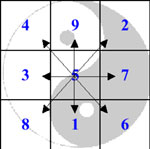 If
you look at the numbers opposite of each other they are adding up to ten you
see that they have opposing YIN or YANG quantities.
2 is in a black (YIN) area and is opposite 8 in a white area (YANG).
4 is in a white (YANG) area and is opposite 6 in a black (YIN) area.
3 is in a white (YANG) area and is opposite 7 in a black (YIN) area.
9 is in a white with some black (mostly YANG) area and is opposite 1 in a black
(mostly YIN) area.
5 has equal YIN and YANG areas.
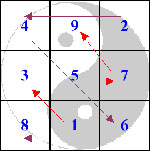 When
we divide the numbers from 1 up to 9 with exclusion of number 5 we get two groups
of numbers, even and odd numbers.
Even numbers are: 2, 4, 6 and 8.
These numbers are YIN but follow a Yang (counter-clockwise) pattern
Odd numbers are 1, 3, 7 and 9.
These numbers are YANG but follow a Yin (clockwise) pattern.
Because in everything YIN is also some YANG the movement is in the opposite
direction at the last pair of number.
Even numbers:
The movement from 2 to 4 (to 5) to 6 is counter-clockwise.
The movement from 6 to 8 is clockwise.
Odd numbers:
The movement from 1 to 3 (to 5) to 7 is clockwise.
The movement from 7 to 9 is counter-clockwise.
 The
odd numbers (red arrows) are tracing the outline of the border of the YIN and
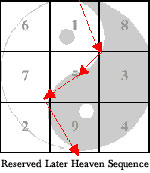
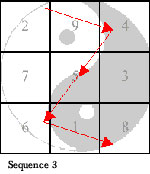
YANG symbol. Only with the even numbers we do have a problem now. But here we
have also to consider the other three possibilities to arrange the numbers of
the LUO SHU so that the result still will be 15 and 10 respectively. Now we
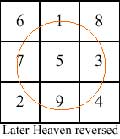
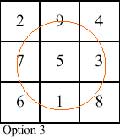
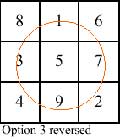
see that in the Later Haven sequence and in the reversed Later Haven sequence
the odd (YANG) numbers are tracing the symbol border, where as in the other
two sequences the even (YIN) numbers are tracing the border.
 |
 |
 |
So we have two times YIN numbers and two times YANG numbers tracing the
outline standing
in harmony to each other. They are creating (following) the TAI JI.
But why have the ancient Chinese picked the LATER HEAVEN sequence and not one of the three other possibilities?
To answer this question we need to look at the properties given to the 9 stars in the LUO SHU.
|
#1 is Yang water |
#6 is Yang metal |
|
#2 is Yin earth |
#7 is Yin metal |
|
#3 is Yang wood |
#8 is Yang earth |
|
#4 is Yin wood |
#9 is Yin fire |
|
#5 is earth |
|
These five elements or transformation are standing in a special relationship to each other. They form a producing cycle, a controlling cycle or a weakening cycle.
|
Producing cycle |
Controlling cycle |
Weakening cycle |
|
Water produced wood |
Water controls fire |
Water weakens metal |
|
Wood produces fire |
Fire controls metal |
Metal weakens earth |
|
Fire produces earth |
Metal controls wood |
Earth weakens fire |
|
Earth produces metal |
Wood controls earth |
Fire weakens wood |
|
Metal produces water |
Earth controls water |
Wood weakens water |
Lets look now on to the sequences following a clockwise and a counter clockwise direction.
 |
 |
 |
 |
Clockwise: Both
Later Heaven sequences are 1-8-3-4-9-2-7-6.
Both
options 3 sequences are 1-6-7-2-9-4-3-8.
Counter-clockwise:
Both
Later Heaven sequences are 1-6-7-2-9-4-3-8.
Both
options 3 sequences are
1-8-3-4-9-2-7-6.
We get two different sequences for the four possible number distributions in the square.
Sequence
1-8-3-4-9-2-7-6:
Water – Earth – Wood – Wood – Fire –
Earth – Metal – Metal
Except the water – earth combination this is the enhancing
cycle.
Sequence
1-6-7-2-9-4-3-8:
Water – Metal – Metal –Earth – Fire –
Wood – Wood – Earth
The wood – earth – water sequence belongs to the controlling
cycle.
The other sequences belong to the weakening cycle.
The
TAI JI is about harmony and creating balance! For that the second
sequence
(1-6-7-2-9-4-3-8) is not fitting into this picture.
At next we have to look at the direction, clockwise or counter-clockwise?
This answer becomes clear when we assign directions to the Luo Shu.
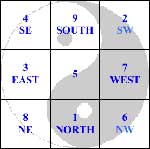 |
Please note that south is at the top. This is the standard the ancient Chinese have drawn their maps in. In Feng Shui studies we use the same form. It is opposite to our western style maps. |
When we are working according to the position of the sun the four cardinal directions showing us the path of the sun.(Clockwise direction of the Tai Ji)
- The south is most hot (White (YANG) in the TAI JI) and stands for highest position of the sun on any given day. Yang is at its peak.
- The
north is most cold (Black (YIN) in the TAI JI) and stands for
the lowest position of the sun (night).
Yin is at its peak. - The
east is gaining light, temperature (White (YANG) is increasing
in the TAI JI)) it stands for sunrise.
Yang is waxing and Yin is waning. - The
west is getting darker, colder (Black (YIN) is increasing in the
TAI JI)) and stands for sunset.
Yin is waxing and Yang is waning.
The movement of the sun is clockwise. For that the Later heaven sequence has been chosen.
When it is possible to project Day and Night onto the Luo Shu and the Tai Ji it is also possible to extend this thought on to the four seasons. #9 is fire and #1 is water. Setting fire (sun) for summer and water (snow and ice) for winter the LUO SHU also represents the seasons.
-
The south is most hot (White (YANG) in the TAI JI) and stands
for summer.
Yang is at its peak.
- The
north is most cold (Black (YIN) in the TAI JI) and stands for
winter.
Yin is at its peak.
- The
east is gaining temperature (White (YANG) is increasing in the
TAI JI)) and stands for spring.
Yang is waxing and Yin is waning.
- The
west is getting colder (Black (YIN) is increasing in the TAI JI))
and stands for autumn.
Yin is waxing and Yang is waning.
#1 water Yang #1
is watering the
#8 earth Yang earth (#8), that holds the seeds to
#3 wood Yang grow plants (#3).
#4 wood Yin Wood (#4) is feeding
#9 fire Yin the fire (#9),
#2 earth Yin burning the earth (#2),
#7 metal Yin to melt out the metal (#7),
#6 metal Yang which will be formed to tools (#6) to dig for water (#1)
Until now we have ignored the number 5. #5 has all the quantities of the other numbers, too. It is the centre. We say it’s element is earth. But this element has to been seen as Earth. Our planet. It is mostly earth (not the surface), but it also has all the other elements. It is the centre of everything. With the number 5 you can also build all the other numbers:
5 + 1 =
6
5 + 2 = 7
5 + 3 = 8
5 + 4 = 9
5 + 5 = 10 1 + 0 = 1
5 + 6 = 11 1 + 1 = 2
5 + 7 = 12 1 + 2 = 3
5 + 8 = 13 1 + 3 = 4
5 + 9 = 14 1 + 4 = 5
Even more clear is this example:
5 + 1 = 6
5 + 2 = 7
5 + 3 = 8
5 + 4 = 9
5 is the
centre, the Tai Ji!
5 – 4 =
1
5 – 3 = 2
5 – 2 = 3
5 – 1 = 4
Sure with the other numbers you can form a similar table.
But the special notion has to be the line 5 + 5. The result is 10.
Ten stands for completion. 1 is Yang and 0 is Yin. It also produces 1 (beginning)
again. 1 and 0 is the universal computer code (Binary system). Any message can
be displayed in an combination of 1 and 0. In the book of change is said: One
becomes two and two becomes three and three becomes every thing.
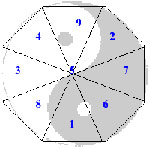 Knowing
now that #5 is everything, we have to redraw the square. Better said, we have
to transform the square into a octagon to visualise this effect.In
this view it becomes clear that #5 is a part of everything. The center number
also rules to which place the other numbers have to fly. For that the
#5 is also called the emperor. Qi is always centering. That’s how #5 is/becomes
everything.
Through this explanation it also becomes clear that it is not logical to place a Luo Shu square over a floor plan to do a Fengshui audit. Qi is moving in/from all directions. Qi is moving from all directions to the centre. When we look at a house Qi is moving towards the centre of the house. When we look at a town it is moving toward the city centre. But this does also indicate that the different stars in one palace are interacting with each other. We have to see which stars are entering the house, which stars can move freely and which stars are blocked.