The Buddha of Infinite Light
Origins of Amitabha Buddha
A very long time ago during the period of Vairocana Buddha, there lived a king who abdicated his throne to become a monk. Dharmadatu was his name and after hearing Vairocana Buddha's words, he made 48 great vows to save all beings from suffering.
After much difficulty and many rebirths, he attained Enlightenment and was named Amitabha, meaning 'infinite light'. In the Amitabha Sutra, the Buddha stated that 10 kalpas had passed since Amitabha became a Buddha.
The Amitabha Sutra
The Amitabha Sutra was translated to Chinese by a famous monk, Kumarajiva (344-413 CE) during the Later Qin Dynasty. The contents of the sutra spread widely and it soon became very popular. It was not long before every Chinese family learnt the words of the sutra and practiced the ways of Buddhism. I took the liberty of summarizing the sutra into a few paragraphs and more comprehensible words.
"Once the Buddha was at Shravasti in the Jeta Grove preaching to a large gathering of Arhats and Bodhisattvas. At that time, the Buddha told Sariputra about a Buddhaland in the West called the world if Utmost Happiness located billions of worlds away. It was in that particular Buddhaland where a Buddha called Amitabha teaches the Dharma to numerous beings He had saved from eternal suffering. That land is called Sukhavati, or known as Pure Land or Western Paradise.
The Buddha described the Western Paradise as a land of pure happiness with jewels and treasures located everywhere. Bright lights, fragrance and music filled the air and the ground was made of gold. Every morning, mandarava flowers would fall like rain, enveloping the land with its sweet scent. Rare and unusual birds in various shapes and colors created by Amitabha Buddha fly freely everywhere, adding to the picturesque of this ultimate heaven. Their clear singing of happiness proclaim the joy of Dharma
Evil does not exist in this land; hence the meaning of it lost upon its blessed inhabitants. The lifespan of Amitabha's disciples and the beings He had saved stretches to several kalpas. Many among these being will dwell in Buddhahood in this very lifetime.
The Buddha then told Sariputra that anyone who, upon his time of death, think of Amitabha Buddha and recite His name sincerely with a clear mind, would be quickly reborn into the Western Paradise."

More on Amitabha Buddha
Amitabha Buddha's most important vow (vow no. 18) was to create a land of boundless joy and happiness, accessible to those who give up unwholesome actions and recite His name with a clear and calm mind. When the time has come for the person to die, Amitabha Buddha will appear before him to take him to the Western Paradise where he would never again have to go through the 6 realms of rebirth.
Amitabha has 2 assistants by His side - Avalokitesvara Bodhisattva on His left and Mahastamprapta on His right. Avalokitesvara, better known as Kuan Yin is a disciple of Amitabha. Her willow and vase is said to carry a person's soul to reside in the Western Paradise. Mahastamprapta (Bodhisattva of Universal Strength), although not as well known as Kuan Yin is also responsible in welcoming loyal devotees of Amitabha to the Western Paradise at the time of their death. She represents Amitabha's wisdom, just as Kuan Yin represents His compassion.
It is said that when Amitabha speaks, the fragrance of the vipala flower exudes from His mouth. Every pore on his body gives off the sweet scent of sandalwood. Wonderful treasures of many kinds could be brought forth with His hands. He is currently residing in His Western Paradise, teaching the Dharma to those He had saved.
The school of Buddhism taught by Amitabha Buddha is mainly based on pure conviction and faith. It is known as the Lotus School of Buddhism, a wing under Mahayana Buddhism practiced mostly in China. One of the reason it achieved so much popularity is because of its simple requirements to attain a stepping-stone to Nirvana. In ancient times, Buddhism texts and scriptures were studied by top scholars and learned laymen. The large population of China was poor farmers who had no access to such luxuries. Hence the simplicity of avoiding unwholesome actions and reciting Amitabha Buddha's name with a clear and sincere mind was easy for many people to follow.
The 48 Great Vows
- If, when I
attain Buddhahood, should there be in my land a hell, a realm of hungry spirits
or a realm of animals, may I not attain perfect Enlightenment.
- If, when I attain Buddhahood, humans and devas in my land should after death fall again into the three evil realms, may I not attain perfect Enlightenment.
- If, when I attain Buddhahood, humans and devas in my land should not all be the color of pure gold, may I not attain perfect Enlightenment.
- If, when I attain Buddhahood, humans and devas in my land should not all be of one appearance, and should there be any difference in beauty, may I not attain perfect Enlightenment.
- If, when I attain Buddhahood, humans and devas in my land should not remember all their previous lives, not knowing at least the events which occurred during the previous hundred thousand kotis of nayutas of kalpas, may I not attain perfect Enlightenment.
- If, when I attain Buddhahood, humans and devas in my land should not possess the divine eye of seeing at least a hundred thousand kotis of nayutas of Buddha-lands, may I not attain perfect Enlightenment.
- If, when I attain Buddhahood, humans and devas in my land should not possess the divine ear of hearing the teachings of at least a hundred thousand kotis of nayutas of Buddhas and should not remember all of them, may I not attain perfect Enlightenment.
- If, when I attain Buddhahood, humans and devas in my land should not possess the faculty of knowing the thoughts of others, even those of all sentient beings living in a hundred thousand kotis of nayutas of Buddha-lands, may I not attain perfect Enlightenment.
- If, when I attain Buddhahood, humans and devas in my land should not possess the supernatural power of traveling anywhere in one instant, even beyond a hundred thousand kotis of nayutas of Buddha-lands, may I not attain perfect Enlightenment.
- If, when I attain Buddhahood, humans and devas in my land should give rise to thoughts of self-attachment, may I not attain perfect Enlightenment.
- If, when I attain Buddhahood, humans and devas in my land should not dwell in the Definitely Assured State and unfailingly reach Nirvana, may I not attain perfect Enlightenment.
- If, when I attain Buddhahood, my light should be limited, unable to illuminate even a hundred thousand kotis of nayutas of Buddha-lands, may I not attain perfect Enlightenment.
- If, when I attain Buddhahood, my life-span should be limited, even to the extent of a hundred thousand kotis of nayutas of kalpas, may I not attain perfect Enlightenment.
- If, when I attain Buddhahood, the number of the shravakas in my land could be known, even if all the beings and pratyekabuddhas living in this universe of a thousand million worlds should count them during a hundred thousand kalpas, may I not attain perfect Enlightenment.
- If, when I attain Buddhahood, humans and devas in my land should have limited life-spans, except when they wish to shorten them in accordance with their previous vows, may I not attain perfect Enlightenment.
- If, when I attain Buddhahood, humans and devas in my land should even hear of any wrongdoing, may I not attain perfect Enlightenment.
- If, when I attain Buddhahood, innumerable Buddhas in the land of the ten directions should not all praise and glorify my Name, may I not attain perfect Enlightenment.
- If, when I attain Buddhahood, sentient beings in the lands of the ten directions who sincerely and joyfully entrust themselves to me, aspire to be born in my land, and call my Name even ten times, should not be born there, may I not attain perfect Enlightenment. Excluded, however, are those who commit the five gravest offences and abuse the right Dharma.
- If, when I attain Buddhahood, sentient beings in the lands of the ten directions, who awaken aspiration for Enlightenment, do various meritorious deeds and sincerely desire to be born in my land, should not, at their death, see me appear before them surrounded by a multitude of sages, may I not attain perfect Enlightenment.
- If, when I attain Buddhahood, sentient beings in the lands of the ten directions who, having heard my Name, concentrate their thoughts on my land, do various meritorious deeds and sincerely transfer their merits towards my land with a desire to be born there, should not eventually fulfill their aspiration, may I not attain perfect Enlightenment.
- If, when I attain Buddhahood, humans and devas in my land should not all be endowed with the thirty-two physical characteristics of a Great Man, may I not attain perfect Enlightenment.
- If, when I attain Buddhahood, bodhisattvas in the Buddha-lands of other directions who visit my land should not ultimately and unfailingly reach the Stage of Becoming a Buddha after One More Life, may I not attain perfect Enlightenment. Excepted are those who wish to teach and guide sentient beings in accordance with their original vows. For they wear the armor of great vows, accumulate merits, deliver all beings from birth-and-death, visit Buddha-lands to perform the bodhisattva practices, make offerings to Buddhas, Tathagatas, throughout the ten directions, enlighten uncountable sentient beings as numerous as the sands of the River Ganges, and establish them in the highest, perfect Enlightenment. Such bodhisattvas transcend the course of practice of the ordinary bodhisattva stages and actually cultivate the virtues of Samantabhadra.
- If, when I attain Buddhahood, bodhisattvas in my land, who would make offerings to Buddhas through my divine power, should not be able to reach immeasurable and innumerable kotis of nayutas of Buddha-lands in the short time it takes to eat a meal, may I not attain perfect Enlightenment.
- If, when I attain Buddhahood, bodhisattvas in my land should not be able, as they wish, to perform meritorious acts of worshipping the Buddhas with the offerings of their choice, may I not attain perfect Enlightenment.
- If, when I attain Buddhahood, bodhisattvas in my land should not be able to expound the Dharma with the all-knowing wisdom, may I not attain perfect Enlightenment.
- If, when I attain Buddhahood, there should be any bodhisattva in my land not endowed with the body of the Vajra-god Narayana, may I not attain perfect Enlightenment.
- If, when I attain Buddhahood, sentient beings should be able, even with the divine eye, to distinguish by name and calculate by number all the myriads of manifestations provided for the humans and devas in my land, which are glorious and resplendent and have exquisite details beyond description, may I not attain perfect Enlightenment.
- If, when I attain Buddhahood, bodhisattvas in my land, even those with little store of merit, should not be able to see the Bodhi-tree which has countless colors and is four million li in height, may I not attain perfect Enlightenment.
- If, when I attain Buddhahood, bodhisattvas in my land should not acquire eloquence and wisdom in upholding sutras and reciting and expounding them, may I not attain perfect Enlightenment.
- If, when I attain Buddhahood, the wisdom and eloquence of bodhisattvas in my land should be limited, may I not attain perfect Enlightenment.
- If, when I attain Buddhahood, my land should not be resplendent, revealing in its light all the immeasurable, innumerable and inconceivable Buddha-lands, like images reflected in a clear mirror, may I not attain perfect Enlightenment.
- If, when I attain Buddhahood, all the myriads of manifestations in my land, from the ground to the sky, such as palaces, pavilions, ponds, streams and trees, should not be composed both of countless treasures, which surpass in supreme excellence anything in the worlds of humans and devas, and of a hundred thousand kinds of aromatic wood, whose fragrance pervades all the worlds of the ten directions, causing all bodhisattvas who sense it to perform Buddhist practices, then may I not attain perfect Enlightenment.
- If, when I attain Buddhahood, sentient beings in the immeasurable and inconceivable Buddha-lands of the ten directions, who have been touched by my light, should not feel peace and happiness in their bodies and minds surpassing those of humans and devas, may I not attain perfect Enlightenment.
- If, when I attain Buddhahood, sentient beings in the immeasurable and inconceivable Buddha-lands of the ten directions, who have heard my Name, should not gain the bodhisattva's insight into the non-arising of all dharmas and should not acquire various profound dharanis, may I not attain perfect Enlightenment.
- If, when I attain Buddhahood, women in the immeasurable and inconceivable Buddha-lands of the ten directions who, having heard my Name, rejoice in faith, awaken aspiration for Enlightenment and wish to renounce womanhood, should after death be reborn again as women, may I not attain perfect Enlightenment.
- If, when I attain Buddhahood, bodhisattvas in the immeasurable and inconceivable Buddha-lands of the ten directions, who have heard my Name, should not, after the end of their lives, always perform sacred practices until they reach Buddhahood, may I not attain perfect Enlightenment.
- If, when I attain Buddhahood, humans and devas in the immeasurable and inconceivable Buddha-lands of the ten directions, who, having heard my Name, prostrate themselves on the ground to revere and worship me, rejoice in faith, and perform the bodhisattva practices, should not be respected by all devas and people of the world, may I not attain perfect Enlightenment.
- If, when I attain Buddhahood, humans and devas in my land should not obtain clothing, as soon as such a desire arises in their minds, and if the fine robes as prescribed and praised by the Buddhas should not be spontaneously provided for them to wear, and if these clothes should need sewing, bleaching, dyeing or washing, may I not attain perfect Enlightenment.
- If, when I attain Buddhahood, humans and devas in my land should not enjoy happiness and pleasure comparable to that of a monk who has exhausted all the passions, may I not attain perfect Enlightenment.
- If, when I attain Buddhahood, the bodhisattvas in my land, who wish to see the immeasurable glorious Buddha-lands of the ten directions, should not be able to view all of them reflected in the jeweled trees, just as one sees one's face reflected in a clear mirror, may I not attain perfect Enlightenment.
- If, when I attain Buddhahood, bodhisattvas in the lands of the other directions who hear my Name should, at any time before becoming Buddhas, have impaired, inferior or incomplete sense organs, may I not attain perfect Enlightenment.
- If, when I attain Buddhahood, bodhisattvas in the lands of the other directions who hear my Name should not all attain the samadhi called 'pure emancipation' and, while dwelling therein, without losing concentration, should not be able to make offerings in one instant to immeasurable and inconceivable Buddhas, World-Honored Ones, may I not attain perfect Enlightenment.
- If, when I attain Buddhahood, bodhisattvas in the lands of the other directions who hear my Name should not after death be reborn into noble families, may I not attain perfect Enlightenment.
- If, when I attain Buddhahood, bodhisattvas in the lands of the other directions who hear my Name should not rejoice so greatly as to dance and perform the bodhisattva practices and should not acquire stores of merit, may I not attain perfect Enlightenment.
- If, when I attain Buddhahood, bodhisattvas in the lands of the other directions who hear my Name should not all attain the samadhi called 'universal equality' and, while dwelling therein, should not always be able to see all the immeasurable and inconceivable Tathagatas until those bodhisattvas, too, become Buddhas, may I not attain perfect Enlightenment.
- If, when I attain Buddhahood, bodhisattvas in my land should not be able to hear spontaneously whatever teachings they may wish, may I not attain perfect Enlightenment.
- If, when I attain Buddhahood, bodhisattvas in the lands of the other directions who hear my Name should not instantly reach the Stage of Non-retrogression, may I not attain perfect Enlightenment.
- If, when I attain Buddhahood, bodhisattvas in the lands of the other directions who hear my Name should not instantly gain the first, second and third insights into the nature of dharmas and firmly abide in the truths realized by all the Buddhas, may I not attain perfect Enlightenment.
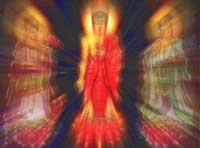
Praise to Amitabha Buddha
"The Amitabha Buddha's body is the color gold. The splendor of His brilliant light is beyond mind. The light of His brows illuminates a hundred worlds. His eyes are pure brilliant light, limitless like the oceans. In Amitabha's realm of infinite light, all beings are transformed And Enlightened into countless Bodhisattvas and Buddhas. His Forty Eight Vows ensure our liberation In Nine Lotus Stages we reach the ultimate shore of Enlightenment. Homage to the Buddha of the Pure Land, Compassionate Amitabha Buddha.
NAMO AMITABHA
BUDDHA!
NAMO AMITABHA BUDDHA!
NAMO AMITABHA BUDDHA!"