| This article brought to you by Feng Shui Times.com (Online Feng Shui Magazines). |

| Ham And Cheese On A Wry Bagua | ||
| Most Western ideas about Feng Shui are utterly wrong and generally based on a variety of weird concepts pulled from European folklore and New Age marketing. Out of the entire scientific system, only a fragment of actual Feng Shui knowledge has reached the public. Despite all of the books rushing into print claiming "Feng Shui this" and "Feng Shui that," the theoretical depth and full potential of the authentic material remain virtually unknown to the public. For Black Sect Buddhists and other New Age types, their Bagua (or Ba Gua, Pa Kua) is a so-called "mystical octagon of symbolic correlations," This cafeteria-style approach to borrowed ideas was whipped into a lovely froth from Western cultural icons and concepts. The new bagua supposedly represents "eight fundamental life conditions" that correlate to "a different aspect of ourselves." Yet it was created within the last twenty years and marketed entirely to New Agers ignorant of Asian culture. - Gao Yung, an esoteric master (Fang Shi) and advisor to Emperor Zheng (33 to 7 BCE) According to Ho Lynn's article in the execrable Feng Shui Anthology (published and edited by Jami Lin), this new Bagua was created by self-proclaimed "wandering impostor" Thomas Lin Yun, founder and spiritual leader of an American minority church called Black Sect Tibetan Buddhism. The new bagua is marketed as a "revolutionary" and "innovative" step in Chinese philosophy. In fact, it is so "revolutionary" that Asians laugh it off and the few sinologists aware of it snort derisively at its mention. As one Korean-American practitioner of martial and healing arts said, "This is the sort of thing that Asians would use to make money off non-Asians." The theories are labeled "Mutationist" for good reason. According to the Feng Shui Anthology, Lin Yun took the Taiji (the Primordial, Great Unity or "Yin Yang symbol," as everyone calls it) and set it spinning in its opposite direction. The Taiji and its corresponding systems move clockwise. A left-spinning Taiji - that is, one spinning counterclockwise - correlates with global culture's views of aberrant behavior, misfortune, and necromancy. 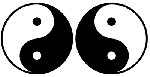 The traditional Primordial or Taiji is shown flowing clockwise. Lin Yun's counterclockwise version is at right. Left (lyft: "weak," "worthless" in Old English) still retains its primordial associations with antisocial behavior and disaster, the concept of sinister ("left hand," "unlucky side"), in Sanskrit sauvastika ("all is evil," movement which upsets the whole of nature). The Tibetan Bon religion uses symbols flowing counterclockwise to indicate black magic and opposition to Buddhism. A movement withershins ("against-direction"), nirrita, or cartua-sul traditionally begins and ends in irreverence, heterodoxy, perversity, death, infertility, and black arts. Another bizarre theory promoted by the church is calling Kan, Kun, Qian, and Li yin guas because they don't look any different when you flip them on their heads. Yang guas are those trigrams that do look different when they're flipped. Flipping a trigram like a burger is a unique approach without any historical precedent - certainly one reason to call this stunt "innovative" in BTB marketing materials and articles. Knowing the telltale direction indicators makes it easy to spot BTB ideas even when they have been repurposed to suit the ideologies of each new book by yet another self-proclaimed "Feng Shui master" who attended a Lin Yun seminar and was exhorted by him to rush out and get a book deal. They share one another's ideas and emphasize various New Age fads, folklore, mythologies, and psychobabble. Not one of these "masters" seems to be able to get the facts straight, which is the first indication that few, if any, have studied authentic Feng Shui or any Chinese science whatsoever. Foundation Theory The foundation of the Yijing is Yi or Change Theory, usually known as Yin Yang Theory. Its theories starkly contrast with those from Black Sect Buddhist practitioners. Yin Yang Theory is the same for authentic Feng Shui practitioners, acupuncturists and other medical practitioners. The different versions of Five Element Theory, part of Yin Yang Theory, are outlined below. Cosmological Sequence This sequence explains which elements (in the sense of phases or processes, not material substances) came into being in what order. No surprises here: Just as evolution explains water-enabled life, as we know it to evolve, so it is considered to have appeared first after Earth was formed. In medicine, this indicates the importance of the kidneys as the foundation of yin and yang of all organs and storehouse of essence that creates qi and mind. (Maciocia p. 23) Enumeration Sequence This sequence explains principles that concern rates of change in processes and sets for the theories that explain the generative (productive) and controlling sequences. Controlling Sequence The Controlling Sequence forms the so-called eternal recycling basis of BTB Feng Shui (Living Color, p. 23). (Never mind that the international symbol for recycling moves clockwise.) This sequence was used in ancient China for fate calculations and politics. Its most famous use was the symbolism of succeeding Chinese dynasties. Rarely used in ecological cycles, because long ago Chinese scientists determined that elements don't perpetually "control" one another. For instance, fire can "control" itself out of existence if it eliminates its fuel source. Used in medicine with the Generative Sequence to keep self-regulating balance in the body. (Maciocia p. 19) Overacting Sequence This sequence follows the flow of the Controlling Sequence but over-controls, causing a decrease, breaking the balance, and creating excesses. Maciocia (p. 20) uses the analogy of "the destructive actions of human beings toward Nature" to explain the workings of this cycle. Too much of a good thing, in this case, does create serious problems. Insulting Sequence This sequence reverses the Controlling Sequence and, like the Overacting Sequence, identifies abnormal relationships. Generative Sequence The Generative Sequence or Mutual Production Cycle (principle of "masking") applies to biology and ecology. It has a very long history as part of Chinese science because it is the only cycle where humans can intervene. It forms the principal process used by authentic Feng Shui practitioners to interact with the environment. Its conclusions depend upon speed, rate, and quantity of a given process. Using this cycle much like a chemist uses compounds (for Daoists who devised Feng Shui techniques also devised alchemy and the foundations of modern chemistry), a Feng Shui practitioner can induce environmental change by adding or detracting from a process (one of the Five Elements) that creates or diminishes another process (another of the Five Elements). In other words, this cycle enables humans to carry fire with them on journeys by knowing how much fuel to give or withhold in order to control it. Much Ado About Clutter The psychobabble of Feng Shui steps sprightly along with the rest of the New Age mythos: With intention, and with clutter out of your way, you can alter the universe. Intuitive Feng Shui relies on the psychic sensitivity of a practitioner (an unknown quantity at best, unless your practitioner has undergone some sort of testing to determine their receptivity) and a perceptual skill William Spear called first impressions that detects so-called "energy patterns" in a home or office. Unfortunately First Impressions has some conceptual flaws. If it is the foundation of Feng Shui analysis, then all our mothers were born Feng Shui consultants. It is a fact of life that some time in your life your mother will walk into your home and complain about your inadequate housekeeping and announce it as the reason you can't get your dream job or find a mate. Some of us think so little of ourselves that we fall for this, which is why sensitive New Age types pay complete strangers good money to hear the same verbal abuse their Mom provides for free. In America, clutter isn't a nice thing to say about how someone lives. In the New Age mind, clutter refers to an arrangement of living and working space that indicates a person's mental state and, by primitive concepts of association, what is happening in their life. As Terah Kathryn Collins claims in The Western Guide to Feng Shui, (p. vii) clutter in a house she was assessing "blocked smooth passage through the house" and therefore explained why the occupants' lives had problems. (If they'd kept their mouths shut, would the living conditions have been an issue?) Karen Kingston defines clutter as "stuck energy" in her book Clear Your Clutter with Feng Shui. And the concept progresses to Maxine M. Shapiro's Clutter! It's Not My Fault! Fix It with Feng Shui. But wait a minute! Despite what you've been told, the amount of so-called clutter in your house has nothing to do with Feng Shui. "Clutter," says Dee Vance, owner of Professional House, a business supplying professional home management and advice, "is just the accumulation of postponed decisions." You haven't taken the time to decide whether to keep something or throw it out, so there it sits until you do. There is no esoteric symbolism influencing your housekeeping - for Dee Vance it is mere procrastination. As we all know, procrastination can have significant effects on many areas of life. Behavior modification, not a rearrangement of furniture, is what is needed to address the issue. In Cheryl Mendelsohn's outstanding book Home Comforts (which everyone should read, because it would stop a lot of needless suffering over this "clutter" nonsense), she says "Health, safety, and comfort matter more than appearances, clutter, organization, and entertainment. A jumbled closet may distract you, but it is much less urgent than clean sheets, laundry, or meals." (p. 18) Who dreamed up the concept of clutter? In European folklore, the blessings of the peasantry's folk-deity (variously Diana, Holda, Perchta, etc.) and visits by the honored dead were bestowed only on "clean places and clean houses" because these supernatural guests "do not like to enter sordid places or filthy houses." (Ginzburg, 1991:101) That's all well and good, but how many of us today are sitting around waiting for the ghost of Grandma or for some peripatetic chthonic goddess to bless our apartments and condos? (And, considering the verbal abuse you suffer from Mom regarding your housekeeping, how do you feel about having Grandma's ghost inspecting the place?) Come to think of it, how many of those peasants actually received blessings of riches and abundance? If you look at the dismal history of the peasantry in continental Europe, the blessings seem to have been of two kinds: Slim and None. Calvinist theology drew upon these ideas to instill the notion that if you were clean in more ways than one, God would provide prosperity (this probably explains why Karen Kingston loves enemas and insists they are part of Feng Shui). The Puritans, being God-fearing Calvinists, brought this "Cleanliness is next to Godliness" concept to the New World. People who dislike clutter tacitly assume everyone should share their Puritan obsessions. The controversy about clutter conveniently ignores the fact that human cultures have wildly varying opinions about it. When we talk clutter, we're really talking about aesthetics. Clutter is a cultural issue, and a good Feng Shui consultant knows it. The faux Feng Shui concept of First Impressions is nothing more than the aesthetic prejudice of an American subculture. Your mother's personal bias, exhibited in her appraisal of your housekeeping and decorating tastes, don't make her - or anyone else - an authentic Feng Shui practitioner. Science to the rescue! "Clutter" can be measured with statistics. Observe the room of a teenage boy a number of times and record how many possible arrangements it has with its current occupant. Repeated visits are the only way to tell if there is a pattern of arrangement and whether the occupant is trying to preserve it -in which case it isn't "cluttered." -Sishi'er zhang jing (ca. 25 to 220 CE) Orientation All living creatures have a strong affinity for the magnetic aspects of Earth. Bacteria and algae follow magnetic lines of force. Sea turtles use a two-way coordinate system based on magnetic dip and intensity. Birds use the Earth's magnetic field as a compass (magnetism geography). Magnetite is found in the brains of dolphins, whales, certain fish (including salmon), green turtles and homing pigeons, and it seems to interact with their brains. Bees rely on the magnetic field to find their way from flowers to the hive. Honey bee dances are tuned to the sun and the local magnetic field direction, as are salmon migrations. Humans are not exempt from these facts. Research shows a correlation between mental illness and disturbed geomagnetic field conditions, as well as correlation between convulsive seizures, myocardial infarction and geomagnetic activity. (W. Campbell: Introduction to Geomagnetic Fields, pp. 241 - 243) Too bad Black Sect and "intuitive" Feng Shui practitioners scoff at the use of a compass or they, like authentic practitioners, could track this activity. After all, the Sipan and Luopan (Feng Shui compasses) were the first geomagnetic field-sensing devices. (Campbell: 175) So how do we perceive the magnetic field? You'll notice there's no listing for intuition. That's because humans cannot detect a magnetic field except by the previously listed means. Without a compass or similar detection device, humans have repeatedly been proven incapable of detecting any kind of geomagnetic field or fluctuation via innate (that is, "intuitive") means. Any Feng Shui book or practitioner who professes an ability to "intuit" energy fields is mentally ill -remember the correlation between mental illness and disturbed geomagnetic field conditions - or expecting another sucker to be born any minute. The Cosmic Lunch Date Think of traditional Feng Shui like meeting a friend for lunch. To meet your friend, she has to tell you several things involving coordinates in space, such as "Meet me at the cafe on the ground floor of the building across from the movie theater on Sunset Boulevard a block west of Doheny." But this is only part of the information you need to meet your friend. You could use this information to get to the cafe, only to discover that you missed her by hours, weeks -- or years. To make the lunch date she has to specify coordinates in space-time. Without the space coordinates (which you have) and the time coordinates- say, noon on July 2, 1999 - you will never be able to make that luncheon date. Authentic Feng Shui, with its coordinates (calculations) in space-time, makes it possible for you to make a lunch date with your friend. The New Age and Black Sect varieties of Feng Shui do not give you that ability because you have no space or time coordinates. To use these systems is to have a friend say, "Meet me for lunch," and have her expect that you will "intuitively" figure out where and when to meet. |