| This article brought to you by Feng Shui Times.com (Online Feng Shui Magazines). |

| Feng Shui Mastery Excursion Series: Imperial China - Day 3 | ||||||||||||||||||||||||||||
DAY 3: Following
the Ancestral Trail: Fu Ling Tombs
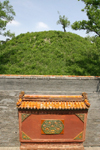
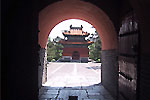
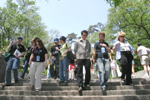
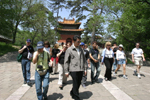
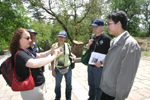
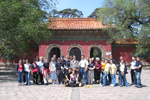
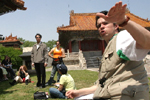
After a short walk through the park grounds and a slightly breathless climb up the 108 steps (which Joey reminded the students, has no Feng Shui significance), the students once again broke into their various groups and commenced their audit, taking measurements with their Luo Pans, looking for the now familiar components of the Sar or land embrace, the water mouth, the Bright Hall and applying the knowledge garnered from visits to Yong Ling on the first day and to the Zhao Ling Tomb the day before.
At Fu Ling, students found a similar example of a Fou Lim burial (above ground burial) but as Joey pointed out to them, Fu Ling is a less superior tomb. What was the reason for this? Strong gusting winds in the area just in front of the tombs mean that Qi disperses quickly and does not collect well in the area where the tomb is located. With only two Bright Halls, the Qi collected is also lesser. The Sar or embrace around the area was also less than ideal – the formation is known as a Fairy Bow formation(Xian Gong Xue) and is not as tight and encapsulating as the embraces seen at Yong Ling and Zhao Ling. Not only is less Qi collected, but it is also not easily ‘held’ in the area, due to the nature of the embrace.
Joey posited that the Dragon Spot (Long Xue) was most likely lower down the hill and not at the location of the tomb. What was the lesson that students walked away with at Fu Ling? Clearly, it was that even Emperors can make mistakes with their own Feng Shui. Despite the likelihood of having excellent advisors, Emperors can still chose a poor burial spot. In the case of Nuerhachi’s tomb, it’s less than favourable Feng Shui resulted in a relatively short reign Shun Zhi, his grandson and son of Huang TaiJi. The comparing and contrasting of the tombs at Zhao Ling with the one at Fu Ling also helped train the students on how to grade Luan Tou structures and to appreciate how important a part a Luen Tou plays in Feng Shui.
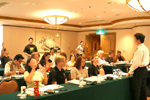
At the recap session later in the day back at the hotel, Joey summed up the key pointers for the students, which they would have garnered from their visits to the Early Qing Tombs (Yong Ling, Fu Ling and Zhao Ling) and the ShenYang Imperial Palace (Gu Gong) “Do you want to face your best direction or be in a location where you have good Qi? If you are already there, then facing your best direction is fine. But if you are in a location where there is nothing useful, is your best direction helpful? Remember the best direction is to receive the Qi. You cannot receive the Qi from nothing!” reminded Joey.
In walking the mountains and visiting the tombs, Joey pointed out to students that this experience should give them a true perspective of the meaning of internal and external Feng Shui: “What is called really external? You have a real river. The fact that you build it in your compound, it is considered within your compound. For simplicity, we say internal and external but what it really means is in the environment.” Visiting the Early
Qing Tombs was designed to give students a sense of perspective about Feng Shui:
“Today, there is a lot of change towards water based formulas whilst in
the old days, mountains were preferred. This is because Water formulas are faster.
Quick in Feng Shui means 12 years. In traditional Feng Shui, the aim is 60 years,
100 years, 300 years – that is what is called traditional Feng Shui”
points out Joey. For more information, please log on to Mastery Academy web site: http://www.masteryacademy.com/ STUDENT EXPERIENCES:
“Today, I think
all of us thought that we were going to find perfect examples of Feng Shui and
we were going to see how the Chinese master Feng Shui and we were going to learn
about this and what we are learning is that masters or supposed masters can
make mistakes. We have a saying in Mexico – I am a Mexican and I am not
a mariachi (the singers with the big sombreros) so being a Chinese does not
mean that you are going to be an automatic Feng Shui master. Joey said it clearly
– these sites that we have been visiting were here before these formulas
were invented so we have to go back to the time when this places were built
and we see that – try to understand why they did it that way and what they
did wrong.”
– JAYNE GOODRICK, UNITED KINGDOM “I learnt to see the mountains from a different perspective. The embrace really puzzled me but what we see today is completely not what we have in paper – for the past few days, when Joey is teaching, this course opens up everything – it makes everything so much easier.” –VIN LEO, SINGAPORE
– DIANE GROBLER , SOUTH AFRICA |