| |
DAY 2: SHENYANG
GU GONG - IMPERIAL FENG SHUI IN CONTEXT
Day 2 of the Mastery Academy
Imperial China Excursion saw the students making their way to the ShenYang Gu
Gong, also known as the 2nd Forbidden City. It is the only other Imperial Palace
outside of the Forbidden City in Beijing.
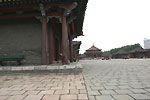 |
Constructed
by Huang TaiJi in 1625 as the new capital of the Qings (previously, the
capital city of the Qing Manchus was He Tu Ala City, which was visited by
the students on Day 1), the Gu Gong or Palace is located within the city
of ShenYang itself and consists of the living quarters of the Emperor and
the Empress as well as a throne room where the Emperor conducted his daily
affairs. The palace covers an area of over 60,000 square metres and holds
many antique items include the waist dagger of Emperor Qian Long and displays
of Manchu hunting bows and arrows. |
Following
the death of Huang TaiJi, the subsequent Qing Emperors ruled from the
former Ming capital, the Forbidden City in Beijing.
The
ride on the bus kicked off with a drive past the Hun River, a river that
curves around the entire city. Students were given a little ‘hint’
by Joey as to what they were to be looking out for but that was it. Joey
reminded everyone that they were here to learn and learning meant figuring
it out themselves and most importantly, making mistakes first! |
 |
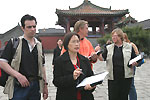 |
A
rainy day threatened to put a damper on the day as students stepped off
the bus at the ShenYang Gu Gong, armed with umbrellas and wondering how
they were going to juggle their Luo Pans in one hand and keep themselves
dry at the same time! Fortunately, the weather cleared up shortly after,
leaving the students to explore the Palace (and check out the Feng Shui
of the area) amidst a cool, and slightly misty setting. |
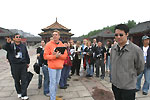
Students had to adapt to
looking at landforms in a different context and put on their thinking caps as
they walked around the massive complex and tried to figure out what to look
for, indeed, where to begin taking their measurements!
| Still
grappling with trying to get around thinking Landform, thinking Embrace,
and thinking about Structure, students nonetheless had fun comparing notes
with each other. Joey then pointed out the Clipper formation, found in the
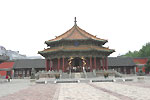
large compound area where the Manchu style throne hall was located, known
as the Da Zheng Dian (Hall of Great Affairs). |
 |
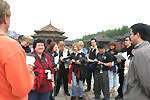
The Clipper formation is
not readily visible to the untrained eye and it was only after Joey walked students
to the far end of the compound did students realise that the structure, when
imagined from an aerial perspective, resembled a person sitting with their legs
splayed apart. Joey explained then that the Clipper formation is usually scandal
causing, leading to sexual scandals and sexual disease.
|
But
while the Qing Emperors had the less than ideal Clipper formation in the
Da Zheng Dian area, the deliberate tilting and elevation of the main building
where the Emperor’s throne was located in the Da Zheng Dian was an
illustration of a intelligent application of Feng Shui, designed to deflect
the Killing Sha coming in from the long straight concentration of Qi. |
There was plenty of other
Feng Shui to be picked up at the ShenYang GuGong. A few students noted the Chimney-like
structure that was near the back gardens of the Palace but were uncertain of
its impact although their instincts told them there was a significance to it.
Quite so! Joey provided
during his analysis session, the missing pieces to the puzzle of the Chimney.
Huang TaiJi died in 1643 after reigning for 18 years. His death was considered
abrupt and sudden but historically, it is thought that he died of a stroke at
the age of 53. He had died in a Jia Shen year, which also coincided with a change
of Period to Period 8. Following Huang TaiJi’s death, the Qings moved
the seat of power and administration from ShenYang to the Forbidden City in
Beijing.
ZHAO LING: A LESSON
ON HOW TO MAKE A MOUNTAIN!
 |
After
a hearty lunch, students took a short 30 minute ride to the next destination
on the itinerary, the Zhao Ling Tomb or North Tomb. The North Tomb is the
location of the tomb of Huang TaiJi, the son of Nuerhachi and grandson of
Nuerba, who’s tomb in Yong Ling Mausoleum was visited by students
of the Mastery Academy during their first day. |
Although HuangTaiJi did
not personally lead the conquest of the Mings, he did lay the foundations for
the Qing Dynasty and thus, is regarded as a Qing Emperor.
|
Zhao
Ling is known as a leading example of the application of the Flat Land
Dragon Theory. Perhaps Zhao Ling provides the answer to the oft-asked
question: is it possible to MAKE a mountain and river, to create the landform
that is needed to produce premium Feng Shui?
Yes,
but only if one can replicate it on the scale and extent in which it is
found at Zhao Ling and only, as Joey stressed during his analysis session,
in the case of Flat Land Dragon. |
 |
 |
Zhao
Ling Tomb is today known as BeiLing Park, it is an extensive and large
park area. To get to the tomb, we had to take a 4km ride on a buggy, and
then cross through 3 large gates before arriving at the massive mould
that is the tomb of Huang TaiJi.
Students
again broke up into their various groups to walk around, take their measurements
and figure out the Feng Shui as it were. As usual, Joey then provided
his thoughtful and thorough analysis of the Feng Shui of the Zhao Ling
tombs. |
| Zhao
Ling is a Fao Lim tomb, as the Flat Land Dragon theory does not involve
burying into the ground, but above ground, so as to receive Heaven Qi. The
theory of the Flat Land Dragon is that by being ‘above’ the
rest, the area automatically will draw in the Qi from the Hun river in the
distance. |
 |
With the river in the distance
pumping out the Qi in to the area, the trick was for the tomb to receive the
Qi, circulate it and contain it within the area, maintaining a constant flow
of Qi in the tomb area.
How then did Emperor Huang
TaiJi ensure optimum descendant luck for his lineage? The Feng Shui solution
took over 12 years to construct!
 |
Ground
was removed to great two great bodies of water, which today, are lakes
in BeiLing park. These acted as a barrier to collect Qi from the river
in a distance. As Joey reminded the students during the pre-briefing,
“Qi is dispersed by the wind, and gathers at the boundaries of water”.
At the same time, the bodies of water represent the application of the
small Tai Ji of the area’s Luan Tou.
The
mound in Zhao Ling, in the shape of a Metal Mountain, thus signifying
prowess in the area of Military Arts, was made from the ground that was
dug out. This potent example of what making a mountain means provided
students with an inkling of just what a monumental task, making a mountain
entails. Indeed, the notion that a rock or even a large boulder could
represent a mountain was well and truly dispelled without doubt at Zhao
Ling, as students realised just what it means to ‘make a mountain’.
|
The burial complex contains
3 Bright Halls, which create the 3 Divide 3 Harmony aspect of the landform.
The 3 layers of Bright Halls act to collect Qi, circulate it and send it into
the tomb. The entire structure of the complex mimics the Sar or embrace of mountains.
Surrounding the grave mound was a tilted walkway, which acted to ensure that
the grave mound did not become waterlogged and which also functioned as the
Cicada Wings.
Zhao Ling represents the
application of Feng Shui in its most simple basic form without the help of formulas
and yet produced superior, Feng Shui, which no doubt contributed to the descendant
luck enjoyed by HuangTaiJi’s grandson, Emperor Kang Xi (1662-1722). Emperor
Kang Xi together with the Emperor Qian Long (1736-1795), was regarded as one
of the most skilled Qing Emperors and also one with the longest reign. Emperor
Kang Xi reigned for 61 one years, a reign matched only by Emperor Qian Long.
For more information,
please log on to Mastery Academy web site: http://www.masteryacademy.com/
|
|
