| This article brought to you by Feng Shui Times.com (Online Feng Shui Magazines). |

| The North South Debate 3'rd Installment | |||||||||||||
New age versus classical The radical
claim of reversing the Ba Gua can be placed in the category of new age
Feng Shui. It is outside the realm of the traditional Ba Gua as arranged
by Fu Xi and King Wen. Their claim for the reverse is not acceptable.
Although the Five Phases became to be commonly associated with the seasons,
they are not seasons. Fire energy associated with the Ba Gua is not the
sun, but just the earth’s magnetic Fire pole. The sun is the most vital
source of life energy, however its pattern is not the message in the Ba
Gua. We cannot change the location of the Trigrams in the Ba Gua, because
these do not show seasons but directional energies. The Luo Shu was not
based on the waxing and waning of seasons. The seasons in the tropical
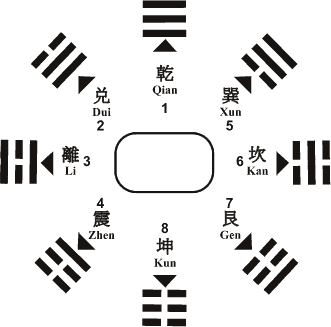
regions only know two: the wet season and the dry season. Finding the correct facing is a skill acquired with practice, making sure the feng shui readings are done correctly and not just a guessing game. Correct reading of the facing and the correct charting gives correct outcomes. It speaks well of a practitioner’s track record to chart the outlook of fortune for years to come. In 1995 when Ms Baxter was asked how she handled a compass in her situation, her answer amazed me no bounds. She revealed she did not use a compass and she did not consult. Yet she was the exponent of a different school of thought. In Eastern philosophy practicing the art is of paramount importance. The common assumption that Westerners have is they can know something by studying it, and then in their wisdom not only want to throw out the fundamentals but want to re-invent the wheel. Copywrite owners of the two Ba Gua The climate argument does not apply to all climates of a given hemisphere. Some even argue that cold winds approach from the North on the Northern hemisphere and cold winds approach from the South on the Southern hemisphere. We cannot base our Qi observations on this for the simple reason that other regions may have their cold winds approach from the Northeast, the Northwest or Southwest even. Arguments to adopt a difference or to discount the difference between both hemispheres are based on the observation of climatic difference and seasonal change. Both schools in the hemispheres debate build their arguments and theories around the five elements as observed through seasonal change, instead of taking earth magnetism as the starting point of Feng Shui. The Early Heaven Ba Gua and why south is placed at the TOP The ancient sages understood the magnetic energies of the earth well. In the traditional Ba Gua of the Early Heaven arrangement, Fu Xi placed South at the top. Qian is located at the top, to signify Heaven above and Kun is placed at the bottom to signify Earth below. The South is Qian (extreme yang), where energies are strong and dynamic. Kun (extreme yin) the Receptive is then placed at the North. Qian Placing them
opposite each other in the Ba Gua denotes: Yin and Yang uniting in harmony.
Through Fu
Xi’s eyes our world view of the perfect universe is opened. The Early
Heaven Ba Gua known as Xian Tian Ba Gua is the depiction of the ancient
world view of nature describing its polarity of energies. The legendary
horse sighted by Fu Xi pointed its head south. It is true, South denotes
warmth and brightness. This is a coincidence. As can be seen, South being
placed at the top does not symbolize the heat or the climate. ‘Fire’ became
associated with the sun, but this is just one of the attributes of Li.
The positions from 1 to 4 locate Qian, Dui, Li, and Zhen: Qian represents Heaven thus on the top and in the south direction. Moving in an anti-clockwise direction they are developed from the yang direction. The positions from 5 to 8 locate Xun, Kan, Gen and Kun; Kun represents the Earth thus placed at the bottom and in the north direction. Moving in a clockwise direction they are developed from the yin direction. They move anticlockwise or clockwise following the principle of yin and yang which is embodied in the symbol of the Tai Chi. Connecting their numbers from 1 to 8 the Tai Chi symbol emerges. Diagram
10
The opposite position for the opposite gua as seen in the Early Heaven pairs denote polarity of energy. The table below shows the paradoxical relationship of the four pairs: Heaven and Earth (Qian and Kun), Mountain and Lake (Gen and Dui), Fire and Water (Li and Kan), and Thunder and Wind (Zhen and Xun) The
Early Heaven Pairs
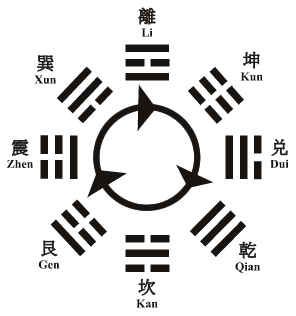
The Later Heaven Ba Gua and why water is placed BELOW Imprisoned
by the tyrant of the Shang Dynasty, King Wen spent his imprisonment studying
the I-Ching. He re-arranged the Ba Gua designed by Fu Xi. According to
scholars it is believed King Wen placed Li at the top to represent the
rising energy of fire and heat, not heat itself. Water is a quality that
runs downwards, seeping into the earth. Hence he placed Kan at the bottom.
Both Li (Fire) and Kan (Water) are polarities symbolizing the major axis
of the earth. Their rightful locations of south and north are places of
the two opposite magnetic forces. Zhen gua sits in the east and the Dui
gua sits in the west. The sun rising in the east dispelling the darkness
of night is characteristic of the Zhen gua. The setting sun casting a
shadow across the sky is characteristic of the image of Dui. THE
LATER HEAVEN BA GUA OR HOU TIEN BA GUA The 28 lunar mansions and the complex systems of calculations. From earliest times the sky has been divided into 28 segments containing the East Sky (Tong), South Sky (Nam), West Sky (Si) and North Sky (Bei). To plan agricultural activity and fortune telling the ancients search the sky for answers. They choose the 28 constellations. Every seven lunar mansions make a group (28 divided by 4 equals 7) Each of the 28 Lunar Mansions consists of an animal and an element. The four animals are the East Green Dragon ruling the east sky, the South Vermilion Bird ruling the south sky, the White Tiger ruling the west sky, and the Black Tortoise ruling the north sky. In fact it is the East Group of the 7 star constellations that the ancients looked at forming the shape of a Dragon when they named the East Sky. Daily observation of the sky to map out the seven stars within each segment. Each day is represented by one animal and this is used in the yearly calendar. Choosing direction as well as time is also based on the 28 lunar mansions. The position of the constellation shifts by one (Chinese) degree every four minutes, everyday. In the time aspects it is combined with the 60-year cycle. Hence the calculation of the 1st day of the 1st yuan of Jia Zi is dependent on this observation. The whole globe is under the influence of one time dimension. The information in the Tong Shu involves complex systems of calculation. It would require an expert in Tong Shu studies to explain the intricacies behind the significance of the prevailing energies of each day as calculated in the Tong Shu. The study of the 4 pillars uses the Chinese calendar. Those who practice 4 Pillars of Destiny learn that the 12 Earthly Branches have hidden element(s). There are 28 hidden stems and the connection is with the 28 Lunar Mansions.
|
 symbolizes
the yang essence. Kun
 symbolises
the yin essence.