| This article brought to you by Feng Shui Times.com (Online Feng Shui Magazines). |

| The 168 Feng Shui Advisors | ||
 Sophia Tang and Chris Shaul When did you first discover Feng Shui? Chris : I first learned about Feng Shui when I was living in Hong Kong in 1993. There I met Master Larry Sang for the first time and I also heard about it from Sophia. While it was all around me, I initially dismissed it. It wasn't until I returned to the US and started attending the American Feng Shui Institute that I realized that Feng Shui is a logical and practical study of the environment. Since I have a computer background, the calculations and methods of Feng Shui immediately clicked with me. Sophia : Growing up in Hong Kong, I saw Feng Shui all around. But as a child, I thought it was completely nonsense. My mother was having a disagreement with the neighbor across from us. The neighbor placed a bagua mirror above the door. So my mother placed one above our door. Then the neighbor placed two bagua's. I thought it was so ridiculous and dismissed it as Chinese superstition. It was not until I met Master Larry Sang in the mid 1980's that I realized that Feng Shui is really a mathematical based science. How long have you been practicing Feng Shui (professionally and personally)? Do you enjoy your work? What are the stress and rewards in this profession? Chris : I began practicing Feng Shui in 1995. I continued to study every weekend with Master Sang at the American Feng Shui Institute for a year-and-a-half. In 1996, under Master Sang's guidance, I began to instruct with the Institute. I have been continuing my studies there and teaching there ever since. In 2000, I helped write and develop the on-line coursework at the Institute. (http://www.amfengshui.com/online.htm) Now, I supervise the on-line classes and the in-person Feng Shui courses at the Institute and currently I am working on developing other coursework on-line. I really enjoy teaching and writing. I also enjoy meeting with clients and assisting them. Sophia : I have been studying since 1992. I am a full-time consultant and teacher. I enjoy consulting and teaching very much. I like people in general, and being able to spend time with them and talking with them is very enjoyable. One of the worries in Feng Shui is when clients do not properly apply the remedies as instructed. Sometimes they think it is more difficult than it really is. Usually, we are able to clarify and help the client understand what needs to be done and they see the results. When I am able to assist my clients in their situations with Feng Shui, it is quite fulfilling. When did you figure out that this (a career in Feng Shui) was what you really wanted to do? Any particular thing or experiences that pushed you in that direction? Chris : Actually, I didn't think about Feng Shui as a hobby, career or anything else until I took my first class with Master Sang. I took it simply out of curiosity to see what Sophia was doing every weekend at these classes. Once I took it, I was hooked. My background is computers and the logical methods and the creative art of the application of Feng Shui really attracted me. Additionally, Feng Shui is a life-long study that you will never outgrow. It is a study of the nature of the Earth, the Universe, and People and how they all work together. It is incredibly fascinating! The best thing is that you can really help people in their lives. That is a great reward. Sophia : I have always wanted a career in Real Estate. Before Feng Shui, I always loved looking at houses and properties. I didn't think of a career in Feng Shui until I took Master Sang's courses. Then suddenly I realized that that was the career I wanted to follow. I get to combine my love of real estate and my enjoyment of assisting people. 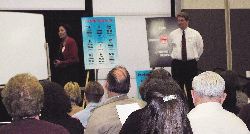 Sophia lecturing in class while Chris looks on Which Feng Shui Masters have you specifically studied with? What led you to them? And any other qualifications you may have taken professionally or otherwise? Chris : We have only studied with Master Larry Sang. Mainly due to the fact that we know in our hearts that he is the correct Master to study under and additionally, we do not want to confuse other materials with what we have already learned. We feel that like a traditional apprentice, that once you find the right Master, study with him for life. I was introduced to Master Sang in 1993 in Hong Kong. Sophia : I was fortunate enough to know Master Sang before he founded the American Feng Shui Institute back in the mid-1980's. He encouraged me to take classes in 1991, after starting the Institute. I took the classes early on in the history of the Institute, but did not do anything with the knowledge for a few years. I just continued to study and take classes, and continue to help others until today. How did Feng Shui help change your life? Sophia : In early 1993, I was planning on moving back to Hong Kong from Los Angeles. I went out with Master Sang for lunch and told him that I had not yet found the right man and that I wanted a new start. Master Sang offered to read my home. We went back and he did the reading. He told me to place water in a couple of places and did an astrology reading. In that reading, he told me that I would have two additional family members within six months. Even though I was leaving for Hong Kong, I realized that it is very difficult to get Master Sang to read your home due to his schedule and that I needed to honor him by following his recommendations. I also thought that there was no way that I would have two people added to my family within such a short period of time. Well, a week after applying the remedies, a friend invited me to a class where I met Chris. We dated until I moved to Hong Kong and then three months later, he moved to Hong Kong! We were married and our son was conceived shortly thereafter. Since in Chinese astrology, conception is the real birth date, Master Sang was right on. I did have two new family members before the end of that year! Chris : I am a Feng Shui Result :-)  Chris and Sophia in class Apparently there are many types of Feng Shui systems practiced today. Which one(s) do you practice and are there any simple ways of defining what is real and what is not? Chris & Sophia : Sometimes what we practice is referred to as "Classical" or sometimes as "Compass School" Feng Shui. Lately, people have classified Feng Shui into different schools such as "Form School," "Compass School," or "Flying Stars School." To us though, it encompasses all of these and is specifically comprised of four aspects: Building, Environment, People, and Time. You cannot have a complete picture of the Feng Shui of a space without utilizing all of the aspects. Most "masters" and books only utilize the first two aspects of the Environment and Building and miss the People and Time aspects. In its most accurate form, Feng Shui analyzes specifically how a building and environment supports the people and how a certain time period affects the house and its occupants. To determine which practice is real or not, simply ask yourself if it makes complete sense. If not, keep looking. Do you use a Luo Pan for your Feng Shui audits? Why or why not? Chris : Yes, Feng Shui without a compass is guesswork. Sophia : While growing up in Hong Kong, I saw Feng Shui practitioners using a Luo Pan for the consultation to determine the orientation for the building. I realize that that is the correct method. From your experiences, what is the most common reaction when your students/clients are exposed to Feng Shui? Chris : Usually, it is fascination. Most people have a sense that their environment affects them, but cannot put their finger on the exact reason. Feng Shui explains this. The second reaction is amazement. When they apply the remedies and see the predicted results, they are amazed. Sophia : I tend to find that my clients are curious and usually have certain expectations. Once I explain Feng Shui to them, they are usually a little surprised that so much of what they have read is actually nonsense. I explain that traditional Feng Shui is logical and only uses the five elements as remedies. So many people have heard only of bagua mirrors, flutes, or other objects that are not part of traditional Chinese Feng Shui. Feng Shui remedies is also not as difficult to do as they expect. 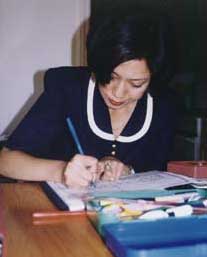 Sophia deep in concentration Tell me about a particularly positive experience in your career that you've had, and then conversely, a negative one, if there are any. Chris : I will briefly share two short stories. The first is about a lady who asked me to do a reading. I discovered she belonged to the Zhen trigram (wood) and lived in a very Metal bedroom. Upon seeing that five years prior, she had an additional strong metal qi in her bedroom for that year, I asked her if she had any throat or nervous system problems that year. (Those are the affected areas of a Zhen trigram.) She replied that that was the year she came down with Parkinson's disease. We moved her bed to another area and added water to strengthen her wood qi nature. She called a month later and said that she could finally sleep through the night and that her disease was not bothering her. Further, she had found a new boyfriend! The other story involved a little baby. I did a reading for a family that had a small baby (less than a year old). This baby was sleeping in one of the worst possible areas with strong earth qi sha. As the baby was Kan (water), I recommended that the baby be moved to another room since it could be affected in the kidneys or bloodstream. They did as I recommended, but the mother was so concerned that she took the baby to the doctor to have him examined. She was horrified to find out that he needed a kidney transplant! So this was both a positive and negative experience. I was pleased that through Feng Shui she was able to get the child treatment, but was heartbroken to hear that this child would have endure these health problems. Sophia : One client of mine called me in to look at the Feng Shui of her house. Her husband had a terrible snoring problem. He had already had three surgeries, but without results. Because of this, he was sleeping in the home office. Their child was also getting in trouble a lot. I examined the house and told her how to place the elemental remedies. She did so and very shortly after, the husband stopped snoring and moved back into the bedroom. Then the child started behaving. Because of the improvements in their life, they became a much happier family. This is one of the many examples from my cases on how Feng Shui can truly impact people's lives. 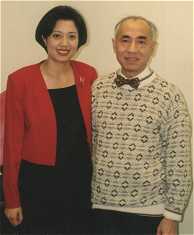 Sophia with her sifu Master Larry Sang How do you know when something positive (or negative) is happening because of Feng Shui applications? How do we measure success of Feng Shui? Chris & Sophia : This is interesting since different people report different results. Some people immediately see dramatic results and others report that they just feel better and are doing better over time. In the bigger scheme of things, Feng Shui is actually not the most controlling influence on our life. There is a popular Chinese saying: "Destiny is first, luck is second, and Feng Shui is third." Then comes generosity and hard work. So some people are destined to have big successes and others are average. But all people can benefit from having a supportive and balanced environment. Properly applied, Feng Shui can make a difference in health, relationships, and prosperity. The success of Feng Shui is measured by the well being of people. Like most things Chinese, it is gray, not black or white. There are variations in degrees. The one thing you can count on is that people do feel better when things are in proper balance. At the recent World Classical Feng Shui Conference (in Cologne), the various Masters talked about San He, San Yuan, Xuan Kong, Ba Zhai, Qi Mun Dun Jia and other sophisticated traditional Feng Shui systems. What do you think of each of these various systems? Their strengths? Their weaknesses? Chris & Sophia : We utilize San He, San Yuan, Xuan Kong, and Ba Zhai. Each needs to be used as a compliment to the other. You cannot use only one method by itself. To have a complete picture, you need to use all four of them. Each of them is a subset of the bigger picture of Feng Shui. Any additional words of advice for our readers? Chris : If it does not make sense, then it is probably not authentic Feng Shui. Additionally, if something looks Feng Shui'd, it is not good Feng Shui. Sophia : In life, it is extremely important to realize the truth and the depth to everything. Therefore, it is very important to be able to understand the depths of Feng Shui. Even in Asia, there is a lot of Chinese folklore, superstition, mysticism and symbolism that people think is associated with the "real" Feng Shui. It is often not what people think. Further, "true" Feng Shui knowledge takes years of study. When something is substantial and has a history of 2,000 to 3,000 years, one or two classes will not enable a person to fully learn Feng Shui. It takes time and effort to really understand the subject. It takes a lifetime to master it. About Chris Shaul and Sophia Tang Chris Shaul and Sophia Tang are the founders of 168 Feng Shui Advisors. They are both Senior Instructors at the American Feng Shui Institute and they are members of the American Society of Feng Shui and the American Yi Jing Study Center. Sophia has provided analysis on large-scale properties, as well as private homes, all over the United States and abroad. Her clientele includes executives in the entertainment industry, real estate industry and other business owners. She has been featured on many newspapers and magazines including New York Times, Los Angeles Times, Dow Jones, E! Entertainment and U.S. Japan Business News. Chris has consulted with hospitals, commercial buildings and offices, retail stores, restaurants, and for homeowners. He has also provided readings for corporations, small businesses and individuals across the US and abroad. He has written and is moderator of the American Feng Shui Institute's on-line correspondence course. E-mail : [email protected] Web site : http://www.168fengshui.com |