| This article brought to you by Feng Shui Times.com (Online Feng Shui Magazines). |

| Qin Shi Huang, The Dragon Emperor | ||
| Yi Zheng ascended the throne after his father's (Yi Ren) death in 221 B.C. At that time he was only 13 years old. Hence the power went to his mother the Empress Dowager and Lü Buwei, the prime minister. When he turned 22, he took away the Empress Dowager and prime minister's power and assumed full control of state affairs. Yi Zheng united the Warring States into a magnificent empire. He named his new dynasty Qin, and he became known as Qin Huang Di (also known as Shi Huang Di. Huang Di in Chinese means 'emperor'). His ambition was to build a great and powerful country and he began by selecting talented and capable men to serve his court. It was not long before Qin became the strongest of the 7 warring states. China was united and Yi Zheng became the first Emperor of China. Qin Huang Di's standing achievements : 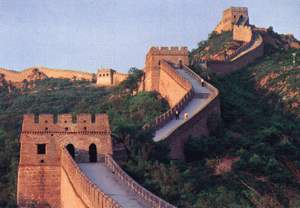 - created a feudal monarchy, bringing system into his ruling. - Mapped out a union of weights and measures. - With the help of his prime minister and an important eunuch, produced the unification of the Chinese written language. - Abolished the currencies of the 6 kingdoms he conquered in exchange for the usage of Qin currency. - Ordered the construction of a road system linking a few states. This system became the basis of ancient roads, which was important for transportation and economic exchanges. - Built hundreds of imperial palaces and developed many cities. - Ordered a massive and extensive tomb to be built for himself. - Started work on the Great Wall of China, one of the Eight Wonders of the World and the only man-made structure that could be seen from space (all 3,000 kilometers of it). As the wise saying goes, no one is perfect, not even emperors. Imagine the whole of China in your hands - what would you do with the power? - Declare war on your neighbors and send hundreds and thousands of soldiers to their deaths. - Burn books on Confucianism and great classic works. Bury more than 460 Confucians alive. Whoever dares disregard the law or express their opinions on state affairs would be killed along with their entire families. - Send a total of 800,000 soldiers to guard Northern and Southern China. - Send 500,000 laborers (mostly prisoners of war) to build the Great Wall of China and watch seven out of ten die from hunger and exhaustion. - Order 700,000 laborers to build your mausoleum. - Send thousands of male and female teenagers on dangerous voyages in search for immortals. - Impose a rule that should one person commit an offense, five households or ten individuals of his relatives be subjected to punishment as well. When Qin Shi Huang died in 210 B.C. (he was 50 years old) his second son, Er Shih succeeded him. He reigned for 4 years before being overthrown by Liu Bang and Han Gaodi who established the Han Dynasty. Qin Shi Huang's Mausoleum Would you plan your funeral? How would you like your funeral to be? A simple ceremony or a lavish affair? The Chinese believe in life after death, be it in hell or another world. Qin Shi Huang however was obsessed with the afterlife (as with many famous kings of great civilizations). When he was fairly young, he ordered a large burial chamber be built for him. Many features were added into the chamber and it was not finished until a couple of years after his death. The Qin Mausoleum, located in Xi'an, Shaanxi province, is surrounded by Mt. Lishan to the south and the Weihe River to the north. Five peaks in the Mt. Lishan served as a backdrop for the tomb and the position of the tomb itself subscribed to the ancient Chinese art of Feng Shui. The whole mausoleum covers 56.25 square km. The tomb was a replica of Qin Shi Huang's world. It was filled with models of palaces, pavilions, ships, precious stones and rare objects. Images of the Yellow River and Yangtze were reproduced using mercury. Indeed, excavations at the tomb site have revealed high contents of mercury in the soil. Crossbows were fixed to shoot thieves and grave robbers. It is said that the ceiling is studded with jewels, replicating the serene sky. Although excavations on the burial site have been going on for more than 2 decades, the official entrance to the tomb has yet to be found. There were no records regarding the entrances or exits of the tomb. After Qin Shi Huang's death, his son Er Shih decreed that his father's concubines who did not bear sons be buried alive in the emperor's grave. The artisans, architects, construction workers and palace guards who knew 'too much' about the mausoleum and its secrets were also buried alive within the tomb. In 1987, UNESCO listed the tomb as a World Heritage Site. Terra Cotta Warriors of the Qin Dynasty 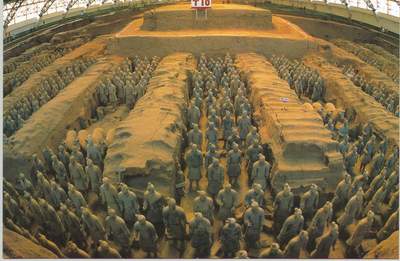 Terra Cotta WarriorsOne of the Eight Wonders of the world, the amazing terra cotta warriors was discovered by accident in 1974 by some peasants who were digging a well. So far, 3 pits containing over 8,000 life-size figures have been uncovered and archeologists think there are more to come. The first pit contains over 2,000 soldiers and investigations suggest that there are still more than 6,000 not yet uncovered. The pit is shaped like an oblong and the warriors are positioned as if getting ready for battle. Armed with crossbows and arrows wit no helmets, they face outwards in a military formation. The second pit is a L-shape and contains a mixture of the infantry, cavalry, archers and charioteers. Measuring over 6,000 square meters, the warriors were divided into 4 smaller formations. The first formation consists of 230 archers, 160 of them kneeling in heavy armors. The second formation is composed of 64 chariots divided into 8 groups. The third formation in the center of the whole pit consists of a combination of normal soldiers and higher-ranking cavalrymen. A statue of a general is also found in this formation. The fourth formation is made up of crossbow archers, chariots and cavalrymen. Each chariot holds two figurines, a charioteer and a scout. The nine ranks of cavalrymen are divided into three groups of four each. Each tall cavalryman with strong features wears full armor and stands beside his mount holding a bow in one hand and reigns in the other. The muscular horses wearing saddles and blankets appear ready for immediate action. The third pit seems to be the headquarters of the army. There are figurines of high commanders, officers and guards of honor. The figurines were placed in 2 rows, facing the opposite of each other. About 130 warriors were unearthed along with one chariot and four terra cotta horses. A remaining sacrificial of offerings for war prayers was also discovered. Swords and other ancient weapons were also discovered. A special kind of surface coating was applied on the weapons to prevent corrosion, an indication of the amazing metal technology in ancient China. This technique was only "discovered" in modern times during the 1930's. Another major discovery is the use of colors in the Qin Dynasty. Despite the peeling of brightly colored paint due to over 2,000 years of corrosion and a major fire, the flakes of remaining paint indicated the figurines were formerly covered with various bright colors such as red, green, blue, white, black and yellow. The height of the warriors varies, according to rank. A normal soldier is about 1.8 meters tall and officers can be about 2 meters. Archeologists believe that real life soldiers in the Qin Dynasty were used to pose for the terra cotta warriors. The figurines were baked in a kiln at temperatures ranging between 950 - 1059 degrees Celsius. Modern attempts at reproducing figurines using this ancient kind of baking process did not produce the good quality found in the terra cotta warriors. Each figurine was painstakingly produced in detail. Some of the potters' names could be found on the figurines. There are 3 groups of hairstyles on the warriors. Some wore buns and braids and others wear caps. The warriors were sculptured in a life-like way and each figurine has his personal character. The expressions of the warriors were so detailed that they seem as if they could breathe on their own. However the most touching part are the eyes. Ancient Chinese believe that the eyes are the soul of a person and therefore the most important factor required to make a statue appear lifelike. Each figurine has intense eyes of yellowish brown irises with black pupils. Travel to China for a glimpse into the past If you ever have the chance to visit Xi'an in China, it is worth your time to visit Qin Shi Huang's terra cotta army. Visitors have been known to burst out in tears looking at the terra cottas. It is said that if you feel an affinity with the figurines, it is most likely that you were once part of the majestic warriors of Qin Shi Huang. To most people, these figurines not only represent China's incredible past but also the astonishing technology of ancient times. The questions arises - how much do we NOT know? |