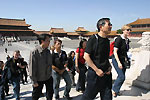
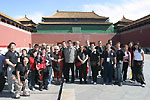
DAY 6: Entering
the Forbidden City
The final day of the Mastery
Academy Imperial China Excursion presented students with two audit conundrums:
the famed Forbidden City in Beijing (Beijing Gu Gong) and the Summer Palace,
located 30 minutes away from the Forbidden City.
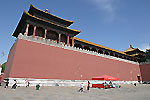
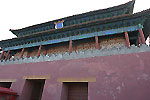
The Forbidden City
took 14 years to build and was the home of 24 Emperors. Its last resident
was the famous ‘Last Emperor’, Aixin Jueluo PuYi, who despite abdicating
in 1912, remained in the Forbidden City for several more years.
Surrounding the Forbidden
City is a 4km wide moat and the complex of palaces covers an area of almost
70 hectares.
Despite the allure
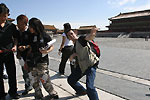
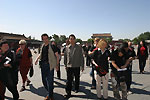
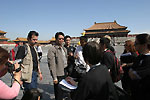
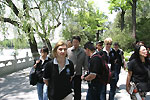
of the Forbidden City, Mastery Academy students were conscious that they were
here to learn and work so in between taking in the breath-taking splendour and
majesty of this symbol of Imperial greatness, students were working hard, taking
directions with their Luo Pan, observing the Bright Halls and building placements,
looking out for clues and hints that would help them judge the quality of Feng
Shui in the Forbidden City. (Joey had of course, provided them with a little
hint the day before, notably, that the Forbidden City had been burnt down several
times).
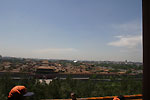
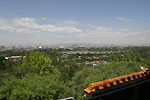
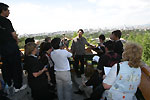
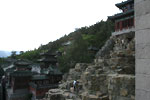
After exiting the Forbidden City, students took a mildly challenging
walk to the top of a small hill, located behind the Forbidden City, known as
Jinshan Hill. Originally an extended part of the Forbidden City’s garden,
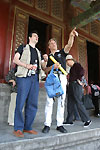
it is today a park. We climbed to a delightful pavilion at the top of Jinshan
Hill, which afforded not only a bird’s eye view of the Forbidden City,
but an excellent vantage point in which to observe the entire city of Beijing,
including its landforms and the location of any water in the area.
 |
With
a gentle breeze blowing and all of Beijing and the Forbidden City beneath,
the discussion on the Feng Shui of the Forbidden City kicked off. There
were no Death and Emptiness Lines at the Forbidden City but students noted
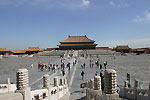
that it faced South, based on direction taken at various points. The Bright
Halls and undulating nature of the courtyards between the main gate and
the key Imperial structures were also picked up by students quickly, who
were already becoming old hands at recognising key building structure hallmarks
for good circulation of Qi and who already were thinking differently and
evaluating with an entirely different eye, the building they were assigned
to audit. |
Students noted
the difficulty in getting a good idea of the structure of the buildings when
they were walking the inside of the complex, which establishes the importance
of seeing a property outside first, rather than inside out. The Forbidden
City receives the dragon vein from noted Chastity Star mountains rising from
NW. This dragon, when verified along with the water position using Long Men
Ba Da Ju formula qualifies as a good incoming dragon. However, good incoming
dragon needs to be accompanied with proper ‘tapping’ of Qi mouth.
In his analysis
session, Joey pointed out that attempting a Flying Star chart of the Forbidden
City would be not just an impossible task but quite useless. Hence, on big properties
or big estates, he said, it is landform (Luan Tou) and structure (Ge Ju) of
the buildings that is the key. The Forbidden City is an illustration of the
Xuan Kong Direct and Indirect Spirit application, albeit, an incorrect application
of it. The positions of water in relation to the Direct and Indirect Spirit
directions is reversed with regard to the Forbidden City. The six ‘lakes’
which forms Bei Hai and ChongNan Hai form an embracing water dragon around the
palace. These water locater were beneficial at certain points during the empire
and detrimental at other times.
Certainly, this
reversal had a part to play in the downfall of the last Ming Emperor, Emperor
ChongZheng, who hung himself on an Elmwood tree on Jinshan Hill as the Qing
tore through the outer gates of the Forbidden City. Joey then pointed out to
the students that if they calculate the Gua of the Emperor ChongZheng, and combine
it with the predictive techniques in Xuan Kong based on a Star Chart of the
Forbidden City and relation to the unique water formation, clearly forecasts
a death by strangulation or hanging.
The bird’s eye perspective
from the top of Jinshan Hill also shows that the internal big structure of the
Forbidden City has a slightly greater prominence accorded to the Right (White
Tiger) side of the complex. Yet again, was the pattern of a higher or more prominent
White Tiger showing up, affirming the course of events that was to unfold during
the Qing Dynasty with 6 out of 12 Qing Emperors were dominated or influenced
strongly by women, the meddling of the Empress Dowager CiXi being the eventual
cause of the decline and ultimate downfall of the Qing, China’s last feudal
dynasty.
Once again, Mastery Academy
students became the first group of students to witness with their own eyes, how
even the greatest symbol of Imperial China and its Emperors, could also be a
living monument of Bad Feng Shui and a testament to the folly of the view that
Imperial Emperors were most certain to have nothing short of top notch Feng
Shui!
White Tiger
Overkill: The Summer Palace.
It is said in the ancient classics “It is better to have
the Dragon higher by heaps than to have the Tiger peeping its head”
After a sumptuous Imperial style lunch at a restaurant in BeiHai
Park (formerly a section of the Forbidden City’s Imperial Gardens), students
headed off for their final audit of the Mastery Academy Imperial China Excursion,
the famed Summer Palace.
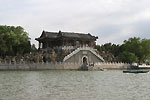
Originally built by Emperor Qian Long (1736-1795) as a gift
to his mother, the Summer Palace (Yihe Yuan) is a sprawling massive pleasure
pavilion of lakes, walkways and gardens, dominated by a huge man-made lake,
Kunming Lake. It took some 15 years to complete and was accessible from the
Forbidden City via a canal that connected the Summer Palace. The formation of
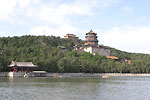
the vein is known as the ‘Bat Holding the Coin’ structure with the
main dragon vein being released from Longevity Hill towards the central axis
of Kunming Lake.
It later became the full
time residence of the Dowager Empress CiXi and subsequently, the place where
she ruled from behind the screen. The Summer Palace was also the place where
the Dowager Empress had her nephew, Emperor GuangXu, imprisoned when he came
of age and tried to seize power from the Dowager after trying to push for reform.
Several students
braved the agrophobia-inducing climb up the Longevity Hill to the Precious Clouds
Pavillion that afforded a bird’s eye view of the entire palace structure.
Once again, Joey left students to look around the place, take their own readings,
evaluate the structure of the buildings and the landform and of course, take
in the beauty of the Palace (which as students were soon to discover, is yet
another monument to Qing folly, at least, when it came to Feng Shui).
The discussion opened with
a lively exchange on the shores of the Lake Kunming, with some students admitting
that they weren’t able to figure the place out (Joey reminded them that
it was perfectly okay and shared his own experience of finding ‘nothing’
when he first came many years ago) and some students noting that the embrace
of the land seemed to shift depending on which part of the park one was in.
Joey, in his inimitable
style, summed up the Feng Shui of the Summer Palace in one word: BAD. The first
boo-boo of the Summer Palace was the massive Kunming Lake, which was essentially,
placing Water smack in the center of the property, a definite no-no as one never
ever disturbs the center. The palace itself was built on the vein of the mountain
but unfortunately, the meridian spot has not ‘fah ping’ – or
slowed down the flow of Qi. The vein is still rushing and has not coagulated
properly.
The structure has no clear
Bright Hall either, which essentially meant that EVEN IF the Summer Palace was
in a prosperous location or landform setting, it had no means to collect and
circulate the favourable Qi around the property.
The
Dowager Empress, upon making the Summer Palace her full time residence,
began a series of constructions and improvements which in essence, shifted
the Facing of the palace and in essence, altered the structure of the
complex, creating a one-sided embrace and upsetting the former balanced
structure of the Palace. Her shift moved the TaiJi Dian of the building
outside and into the water.
The protruding
Pagoda in the distance, pops up as a clash between Mao and You on the
Luo Pan known as “the gate of the sun and moon”, which signifies
sexual scandal and sexual disease, a fate that befell Emperor GuangXu’s
predecessor, Emperor TongZhi, who was renown for his late night escapades
to brothels in the former Red Lantern District of the Forbidden City and
who later died of syphilis.
|
|
Viewed from certain vantage
points, the landform and embrace around the Summer Palace appears to create
a strong White Tiger but virtually no Green Dragon at all, supporting the tremendous
power the Dowager Empress CiXi wielded ruthlessly over 3 Emperors. The repositioning
of the Summer Palace then allows the White Tiger to be seen in a special curling
embrace formation.
|
Given
the appalling state of Feng Shui in the Summer Palace, why on earth was it constructed the way it was in the first place? Surely Imperial Feng Shui
advisors were not that careless? (although one must remember, if even the
great Emperor Qian Long could have his tomb face a Death and Emptiness Line,
there would be no limit to how bad Imperial Feng Shui could get!). |
The explanation was quite
simple. Emperor Qian Long built the Summer Palace simply as pleasure palace
– a spot to come and relax, drink wine, perhaps take a sail on the lake
and even spend the night with a concubine. It was never intended to be a building
for the conduct of business and administrative affairs. This all changed when
the Dowager Empress CiXi made it her full time residence in effect, the place
where the business of the Imperial Empire was conducted, when she began to no
longer rule from behind the screen.
For more information,
please log on to Mastery Academy web site: http://www.masteryacademy.com/