DAY 5: EASTERN
QING TOMBS, ZUI HUA CITY, HEBEI PROVINCE
 |
DAY 5 of the
Mastery Academy Imperial China Excursion began with an early 6am wake-up
call. We had a 3 hour, 125 mile journey to the Eastern Qing tombs ahead
of us and with 4 tombs to inspect at the site, a 7.30am kick-off was an
absolute necessity. |
The Eastern Qing
tombs is essentially a large Spiral City "Luo Cheng" (the term used
to describe the area that is encapsulated and encompassed by Sar or embraces
all around it). 6 Emperors are buried in the Eastern Qing Tombs, including 2
of the most famous Qing Emperors, Emperor Kang Xi and Emperor Qian Long. It
is also the site of the tomb of the infamous Dowager Empress CiXi.
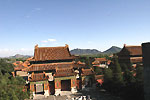
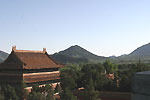
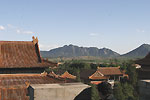
On the way, students
saw the familiar signs of the Emperor Formation, starting with the Flag (Qi
Feng) and Drum Mountains (Gu Shan), and Chastity Mountains (Lian Zhen Xing Ti)
in the distance gradually sending out the Dragon's Veins (Long Mai) and tantalisingly
leading us closer and closer to the Qi powerspot, the Dragon Spot (Long Xue).
Students were now getting accustomed to spotting the different types of mountains
and most importantly, distinguishing them - a case of knowing one's Table Mountain
(An Shan) from one's Greedy Wolf (Tan Lang Xing). All these visual indicators
were much clearer than the ones seen on the first day of the Imperial China
Excursion on the way the Yong Ling Mausoleum, or perhaps it simply was that
students were slowly but surely, getting to grips with spotting the Luan Tou
(Land Forms Feng Shui) and reading the mountains! Many students felt a great
sense of achievement and excitement as the forms like Flying-Goose Tent Opening
(Fei Ngo Dai Xiang) and Prawn Whiskers (Xia So) started becoming immediately
apparent.
Power to the
White Tiger
From the marble
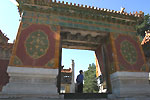
gates that mark the entrance into the massive cemetery complex, the bus rumbles
12 miles to reach the site of the first tomb to be audited by the students,
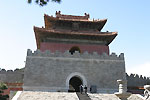
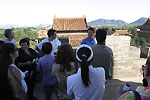
the tomb of Qing Emperor, Shun Zhi. After a quick walkabout, Luo Pan measurements
and taking in the splendour of the mountain vistas from the top of the tomb,
Joey shared his analysis with the students before we sped off to the next tomb
on our list, the tomb of one of the most famous Emperors of the Qing Dynasty,
Emperor Kang Xi.
Both Shun Zhi and
Kang Xi secured excellent burial spots for themselves, with superior landforms
surrounding the tomb area, a burial that reaches the critical Dragon Spot (Long
Xue) and facing a Rising Mountain (Zhao Shan) ahead. Students noted however
that in both these sites, the White Tiger Embrace was higher than the Green
Dragon Embrace. This explains the empowering of the Empress during the reign
of Shun Zhi and Kang Xi and also repeats the pattern found at the Yong Ling
tomb in ShenYang.
The real fun began
after a quick lunch at a nearby hotel within the Eastern Qing Tombs as students
headed to the tomb of Emperor Qian Long.
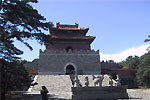
"Beautiful
is not always Good" - Emperor Qian Long's Tomb.
Click the photo to enlarge.
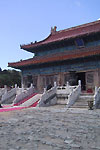
Regarded as one
of the more opulent tombs in the Eastern Qing Tombs, Qian Long's tomb was built
over 12 years, at a cost of over a million taels of silver. The tomb is built
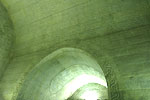
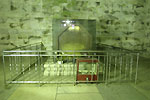
into the ground to tap the Dragon's Spot and its interior is entirely made of
marble stone.
Qian Long's tomb
also comes with a fascinating legend. The story goes that Qian Long, who reigned
for 60 years (and another 4 more years from behind the screen as the Supreme
Emperor, following his 'abdication' in 1795) was renown as a man of many talents
and skills. He was a hunter, a scholar, a poet and therefore, unsurprisingly,
an apt student of Feng Shui.
Emperor Qian Long
selected the Dragon Spot himself and then marked it by burying his jade ring
in the spot which he regarded as the spot. He then sent his Imperial Astrologer
to double-confirm the location of the spot, which the Imperial Astrologer duly
did.

|
Di
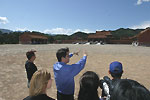
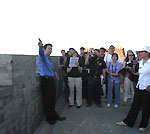
Grobbler volunteered to take a quick Luo Pan reading at Qian Long's tomb.
Students were completely blown away as Di returned to the spot where everyone
had gathered for the analysis session to report that the tomb was in fact,
square on the Death and Emptiness Line! A mind-boggling possibility it was
but as Joey reminded the students, even Emperors make mistakes with the
Feng Shui, and yes, to the extent of placing the Facing of the tomb squarely
on a Death and Emptiness Line.
Ominously, this particular
Death and Emptiness Line signifies 'Evil Woman' and again, ties in with
the eventual decline of the Qing Dynasty in the hands of the decadent
and ruthless Dowager Empress Ci Xi.
(Note that there are many types of Death and Emptiness Lines. Each one
carries a different effect).
|
| The
mitigating factor was the excellent structure of the landform around Qian
Long's tomb site. Accordingly, pointed out Joey, the fact that the facing
of the tomb was far from ideal did not bring a disasterous outcome immediately,
although it is clear from history that Qian Long's descendants did not enjoy
good luck, with the quality of character of each Emperor that followed Qian
Long declining and eventually, succumbing to the controlling influence of
the Dowager Empress CiXi. |
|
|
What went
wrong?
It may simply have
been a genuine mistake. Joey added that on his first visit to the tomb,
he found it mind-boggling that such a dire mistake could be made. But
it affirmed several points: one, doing your own Feng Shui is not always
a good idea and two, that even Emperors can have bad Feng Shui!
|
Perhaps as an omen
of ill-portents to come, Qian Long's tomb, despite the lavish amounts spent
on it, eventually become waterlogged, considered to be an extremely inauspicious
occurrence.
The final tomb
on the Eastern Qing Dynasty trail was the tomb of the Dowager Empress Ci Xi.
Even more opulent than Qian Long's tomb, Empress Ci Xi's tomb is a testament
to how good Feng Shui makes no difference if one has no descendants who can
benefit from the good luck.
The Dowager Empress
was the iron fist in a velvet glove - ruled 'behind the screen' throughout the
reign of 3 Emperors (and was the hand behind the selection of Pu Yi, the famous
Last Emperor), Ci Xi was rumoured to have had a hand in the death of the Eastern
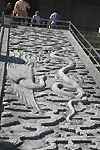
Empress and the poisoning of her own son, the Emperor Tong Zhi. Her tomb is
marked by numerous motifs of the Phoenix, rising above the Dragons, symbolising
her control over the Emperor.
In murdering her
own son, the Dowager Empress rendered meaningless and pointless, the locating
of her tomb in a good site within the Eastern Qing Tombs. Ci Xi's tomb is also
a good illustration of a burial into the ground that MISSES the Dragon Spot!
With the visit
to the Qing Tombs, students have followed the ancestral path of the key Emperors
in the Qing Dynasty, from Nuerhachi to Qian Long and studied their Yin Houses.
The final day of the Imperial China tour will see students take to the famed
Forbidden City and Summer Palace in Beijing to tie in their Yin House findings
with Yang House analysis.
For more information,
please log on to Mastery Academy web site: http://www.masteryacademy.com/