|
|
 |
|
|
| |
|
| |
|
| Feng Shui Mastery Excursion Series: Imperial China - Day 4
|
|
DAY 4: YONGHE LAMASERY,
BEIJING
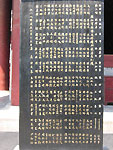
|
The
day started bright and early for the students of the inaugural Mastery
Academy Imperial China Excursion as we caught the 9am flight from ShenYang
to Beijing.
The last
3 days in ShenYang saw students going far and wide in the Liao Ning Province
in their quest for greater understanding and appreciation of Luan Tou
(Classical Land Forms Feng Shui) and in the task of training their eyes
to search and identify the incoming Dragons (Lai Long), the Dragon Spot
(Long Xue), Water Mouths, Water Flow and Rivers. They had walked the mountains
(albeit in a bus!) and saw real mountain examples of the Gou Kong Long,
Ping Kong Long and Ping Yeong Long (High Protruding Mountains, Mid Range
Mountains and Flat Land Dragon). |
| After
a fortifying lunch, students were ready to tackle the challenge posed
to them at the Yonghe Lamastery in Beijing, the first stop in the Beijing
leg of the Mastery Academy Imperial China Excursion.
What is the
significance of the monastery? From a broader overview, the students were
essentially tracking the Feng Shui of the Qing Dynasty through the generations.
|
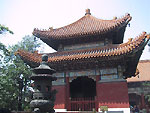 |
The last 3 days
in ShenYang focused on the Feng Shui of the first three Emperors of the Qing
Dynasty, Nuerhachi, his son, Huang TaiJi and Huang Tai Ji’s son, Shun Zhi.
Students were evaluating both the Yin and Yang Houses, with landform structure
at the forefront of the audit and analysis.
Yin Houses evaluated
were the tomb of Nuerba, grandfather of Nuerhachi and the tomb of Nuerhachi
and Huang Tai Ji respectively. Yang Houses evaluated were the ShenYang Gu Gong
or Imperial Palace and He Tu Ala City, both which served as the capitals and
seat of power for the Qings, until the seat of power moved to Beijing with the
accession of Emperor Shun Zhi.
|
Day
4 saw students coming back to evaluating Yang Houses, armed with the experience
they had garnered from the previous 3 days. Prior to becoming a Lamasery
in 1744 during the reign of Emperor Qian Long (1736-1795), Yonghe Gong
(as it was then known) was the palace residence of Prince Yong (YinZhen),
the 4th son of Emperor Kang Xi (1662-1722) whom later become the famous
Emperor Yong Zheng and the birthplace of Emperor Qian Long.
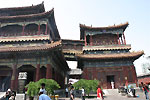
Yonghe Lamasery
was chosen by Joey for an audit for several reasons but the key linkage
to the Qings was that this was the palace that that spawned two Emperors.
It was certainly worth taking a look to see what exactly gave this palace
its exceptional Emperor-producing prowess. |
|
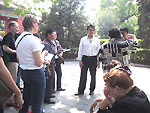
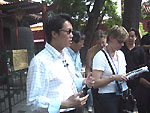
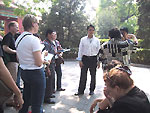
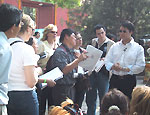
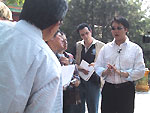
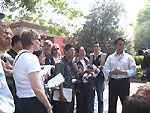
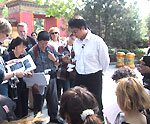
As before,
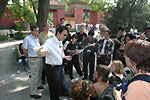
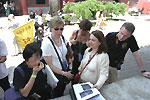
students were given the opportunity to walk around the sprawling grounds
of the lamasery and to pay respects to the famous 23 metre tall Maitreya
Buddha, carved from a single white sandlewood tree trunk and which is
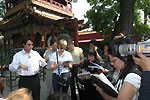
recognised in the Guinness Book of Records. Students then gathered to
share their findings with each other in the shaded grounds just outside
the lamasery.
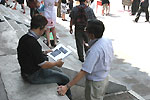
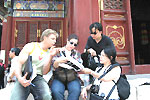
With their
prowess in observing structures growing each day, students were well-prepared
for the analysis session. They had learnt to immediately zero in on the
layout map of the palace (which was also found in most of the other sites
visited) so as to assist them in picking out the Bright Hall and observing
the way the building was laid out, structurally. Some had also quickly
bought maps of the city, so as to be able to observe the location of the
river in relation to the lamasery.
|
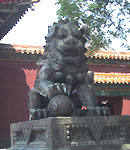 |
|
The
presence of the river at the back of the lamasery was a cause of confusion
for some, the prevailing ‘idea’ being that water at the back is
not ‘good’. Students also picked up that the lamasery, being a
long building rather than a rectangular one, had long Qi. The building also
had 3 Bright Halls and each tier of buildings was slightly elevated. |
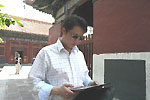
Naturally, Joey
allowed all the students to explore their ideas and theories before launching
into his own analysis. Students had picked up most of the key points but Joey
helped put the finishing touch to the observations when he pointed out that
not only were each tiers of the buildings elevated, but the entrances to each
‘section’ were built in a manner to prevent the escape of Qi and to
keep it circulating and undulating around the building.
| The
elevation in the first tier at the main door was to deflect the Killing
Sha from the long straight entrance into the lamasery. The Bright Halls
collected the Qi, and the zig-zagged corridors and undulating tiers worked
to circulate and contain the Qi. Hence, the presence of water at the back
of the lamasery, from the river, did not affect the palace, due to the superior
structure of the buildings. Superior structure, according to Joey’s
analysis is qualified by the land formation which was matching with a special
Xuan Kong Da Gua configuration. This was made effective with the natural
river that was at the rear of the palace. The Yonghe Gong’s feng shui
is based upon the principles of flatland dragon theory and Qi distribution.
|
 |
Of course, the
good Yang House Feng Shui alone was not what helped propel Prince YongZheng
and his son, Qian Long to the throne of the Qing Dynasty. But put together with
the favourable burial spot of the tomb of his great-grandfather Huang Tai Ji
at Zhao Ling and the Emperor Formation to be found at the tomb of YongZheng’s
great-great grandfather Nuerba, the superior structure of his palace was the
extra zing needed to ensure YongZheng and his son, Qian Long would ascend to
the Qing throne.
For more information,
please log on to Mastery Academy web site: http://www.masteryacademy.com/
|
|
This article is brought to you by |
|
Bernice Low
Bernice Low has been writing since 1992 and has since published in the Star and various Malaysian magazines, including Her World, Men’s Review and Education Quarterly. Bernice served as Editor (and later columnist) for the Malaysian Star Trek Fan Club’s quarterly publication, DATABANKS and as Design Editor of IMPACT, a weekly campus publication of the University of Nottingham, UK. She also briefly served a stint as Junior Copy Editor and writer at The Edge, Malaysia’s leading financial publication.
|
|
|
|
|
|
|
|
|
|
| |
|
|
|