At
the end of this article, I will use a typical house plan to show where
I would locate and actuate the wealth position using these methods.
Feixing Pai (the Flying Stars School)
Feixing or Flying Stars refers to the stars (that is the numbers) in
a Luoshu diagram. A Luoshu Diagram is a 3 x 3 ‘magic square’
- where every line of numbers; vertical, horizontal and diagonal, add
up to 15.
(Refer Diagram 2)
Following the numerical cycle 5,6,7,8,9,1,2,3,4,5 identifies the fixed
“forward flying” pattern of the “stars” (numbers).
(See arrows on Diagram 2).

Diagram
2 “Flying Stars” pattern in a Luoshu Diagram
The eight directions South, South East, East, North East, North,
North West, West and South West are shown. The name for each
of the eight “palaces” (sectors of the diagram - excluding
the centre)
is shown next to its direction.
The
centre number of the diagram changes according to a pre-determined cycle
of time based on twenty year and yearly cycles. These cycles are calculated
from the birthday of the Yellow Emperor. By consulting the Tong Shu
(the Chinese Almanac) you can see which star flies into the central
‘palace’ each year. The same “forward flying”
pattern is applied to the diagram, following the numerical cycle 5,6,7,8,9,1,2,3,4,5,
to determine which “stars” fly into which “palaces”.
To determine the yearly or twenty yearly wealth position we look for
the ‘palace’ where the ‘star’ (or the number)
8 ‘flies’ into. The 8 ‘star’ called the Zuofu
Star is considered to be an auspicious star related
to wealth.
Let us look at an example:
In the year 1995, the five star “flies” into the central
“palace”. If we construct the flying pattern (Refer to Diagram
3) we can see that the 8 star is in the Gen Palace (the north east),
which makes the North East the wealth position for the year 1995.
SE |
|
|
S |
|
|
SW |
|
XUN |
|
LI |
|
KAN |
|
|
|
4 |
9 |
2 |
|
|
E |
ZHEN |
3 |
5 |
7 |
DUI |
W |
|
|
8 |
1 |
6 |
|
|
|
GEN |
|
KAN |
|
QIAN |
|
NE |
|
|
N |
|
|
NW |
Diagram
3 Yearly Flying Stars Pattern for 1995.
For
the year 2000, the nine star flies into the central palace. If we construct
the yearly flying stars chart as shown below (Diagram 4) we can see
that the 8 star is now in the Xun Palace (South East), which makes the
South East corner of the house the wealth position, for the year 2000.
The 8 Star is also the ‘sheng qi’ (or the vitality star)
for the seventh period (1983-2003), because it is the same number of
the period to follow (the eighth period is from 2004 – 2024).
SE |
|
|
S |
|
|
SW |
|
XUN |
|
LI |
|
KAN |
|
|
|
8 |
4 |
6 |
|
|
E |
ZHEN |
7 |
9 |
2 |
DUI |
W |
|
|
3 |
5 |
1 |
|
|
|
GEN |
|
KAN |
|
QIAN |
|
NE |
|
|
N |
|
|
NW |
Diagram
4 Yearly Flying Stars Pattern for 2000
There
is another way of calculating the Wealth Position according to a 20
year cycle. The method not only takes into consideration a longer time
cycle but also the orientation of the house. For example, for a house
constructed in the 7th Period (1984-2003), sitting due north and facing
due south, the flying stars chart is constructed as shown below in diagram
5.
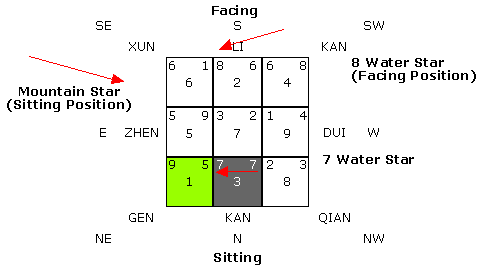
Diagram 5 Showing Flying Stars pattern for a
house constructed in the 7th Period.
Sitting due North and facing due South
From
diagram 5 we can see that the north is where the 7 water star has landed,
so north is considered to be the Wealth Position for this house constructed
in the 7th Period.
We can also see that the 8 water star is located towards the SW, making
it a secondary wealth position for the house.
You need some knowledge of the Flying Stars calculations to work out
the charts for different houses with different orientation and construction
periods. The idea is to look for the star for the period you are in.
Therefore after 2003, you should look for the 8 water star for the wealth
position and the 9 water star will become the secondary wealth position.
Bazhai Pai
The Bazhai Pai or the ‘Eight Houses’ School uses the Sheng
qi (or Vitality) sector as its wealth position. The eight houses refers
to the eight sectors or palaces of the Luoshu Diagram (Later Heaven)
Bagua (Refer to Diagram 5) The central palace is not named.
SE |
|
|
S |
|
|
SW |
|
XUN |
|
LI |
|
KAN |
|
|
|
8 |
4 |
6 |
|
|
E |
ZHEN |
7 |
9 |
2 |
DUI |
W |
|
|
3 |
5 |
1 |
|
|
|
GEN |
|
KAN |
|
QIAN |
|
NE |
|
|
N |
|
|
NW |
The
eight palaces are classified into West Four Gua (Kun, Dui, Qian and
Gen) and East Four Gua (Li, Kun, Zhen and Kun).
By using a compass we can determine the directionality of a house, that
is in what direction the house sits and faces from this we can work
out what the type of a house it belongs to and where is the sheng qi
sector. For example if the house is sitting on North West and facing
South East it is a Qian house (zhai gua = qian) and the sheng qi sector
is located at the west, therefore the wealth position is to the west.
A secondary wealth position is located at the Yan Nian (Longevity) sector.
Both the sheng qi and Yan Nian position can be calculated from the Song
of the Big Yearly Cycle or the Da Yu Nian Ge. For convenience I have
summarised these two positions for the eight different house types below
House
Type
|
Primary
Wealth Position |
Secondary
Wealth Position |
| Zhai
Gua
(Sitting Direction) |
Sheng
Qi
(Vitality Location) |
Yan
Nian
(Longevity Location) |
| West
four House |
| Kun
(SW) |
NE |
NW |
| Dui
(West) |
NW |
NE |
| Qian
(NW) |
West |
SW |
| Gen
(NE) |
SW |
West
|
| East
four houses |
| Li
(South) |
East |
North |
| Xun
(SE) |
North |
East
|
| Zhen
(East) |
South |
SE
|
| Kan
(North) |
SE |
South
|
Referring
to the Chart, so if your house faces the north (that is it sits on the
south) you have an East Four Li House and the primary wealth position
(sheng qi) is located in the east and the secondary wealth position
(Yan Nian) is located in the north.
San Yuan Pai
San Yuan Pai or the Triple Primaries School, like the Feixing Pai uses
the 3 Yuan (3 cycles of 60 years each and 9 Yuan (9 periods of 60 years
each) and 9 Yun (9 periods of 20 years each) to do their calculations.
The cycles and periods of time (refer Table 2) is transplanted onto
the Luoshu Diagram to give a correlation between space and time.
| Cycle |
Period |
Years |
Upper
Yuan
|
1st
Yun |
1864
– 1883 |
2nd
Yun |
1884
–1903 |
3rd
Yun |
1904
– 1923 |
Middle
Yuan
|
4th
Yun |
1924
– 1943 |
5th
Yun |
1944
– 1963 |
6th
Yun |
1964
– 1983 |
Lower
Yuan
|
7th
Yun |
1984
– 2003 |
8th
Yun |
2004
– 2023 |
9th
Yun |
2024
– 2043 |
Table
2: Showing Time Cycle of the 9 Periods from 1864 – 2043.
Since
we are in the lower cycle of the 7th Yun (1984-2003). The number 7
(West) in the Luoshu Diagram becomes the “Zheng Shen”
or the “Principal Spirit” of our time (Ref. Diagram 6).
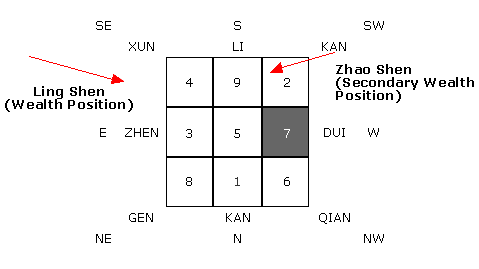
Diagram 6: Luoshu Diagram Showing Position of Zheng Shen for the 7th
Period (1984 – 2003)
Opposite
to the Zheng Shen (East, number 3) is the Ling Shen the Zero (as in
origin) spirit. The San Yuan Pai rule says that if there is water
in the Ling Shen direction, wealth will come with the water.
So the Ling Shen becomes the wealth position if we charge it with
water (Refer Diagram 6)
After 2003, we will enter the 8th Period (2004 – 2023) and the
Zheng Shen will shift to the NE (number 8) and Ling Shen will be in
the SW. SO if you put water in the SW direction after 2003 you will
activate the wealth qi of the house there (Refer Diagram 7).
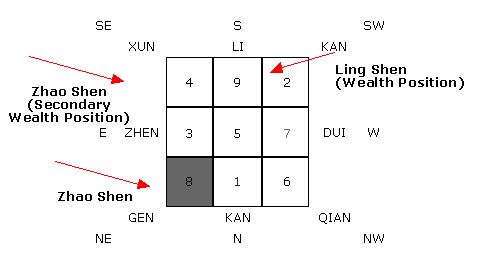 Diagram
7 Luoshu Diagram Showing Position of Zheng Shen and Ling Shen for
the 8th Period
A
secondary wealth position can be obtained by looking at the Hetu Coupling
of 1,6; 2,7; 3,8; and 4,9 numbers (Refer Diagram 8)
| |
|
|
S |
|
|
|
| |
|
|
7
2 |
|
|
|
| |
|
|
|
|
|
| |
8
3
|
10
5
10 |
4
9
|
|
| E |
W |
| |
|
| |
|
|
1
6 |
|
|
|
| |
|
|
|
|
|
| |
|
|
N |
|
|
|
Diagram
8, Hetu Diagram Showing Coupling of Heaven and Earth Numbers.
Since
these pairs of numbers represented Heaven (Odd Numbers) and Earth
(Even Numbers) coming together to achieve harmony in the Universe
we look at the pairing of 1,6; 2,7; 3,8; 4,9; 5,10 in the Luoshu Diagram.
So in the 7th Period, the Luoshu number 2 or the SW becomes the secondary
wealth position called the Zhao Shen or the Reflected Spirit.
For the 8th Period, the Luoshu Number 3 the East direction becomes
the Zhao Shen, the secondary wealth position from 2004 – 2023.
San He Pai
San He Pai or the Triple Combination School uses the 12 Zodiac Animals
orientation as the wealth position. As the name implies the 12 animals
are grouped into combinations of 3 and their locations are marked
on the compass shown in Diagram 9 below.
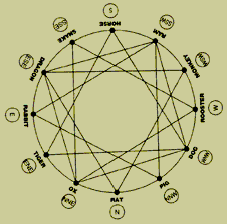
Diagram 9 “San He” or “Wealth Position” A
total of 5 sets of combinations.
There
are a total of 5 sets of combinations shown below:
1. Water Combinations
Monkey (WSW), Rat (N) and Dragon (ESE)
2. Fire Combinations
Tiger (ENE), Horse (S) and Dog (WNW)
3. Metal Combinations
Snake (SSE), Rooster (W) and Ox (NNE)
4. Wood Combinations
Pig (NNW), Rabbit (E) and Ram (SSW)
5. Earth Combinations
Dragon (ESE), Ox (NNE), Dog (WNW) and Ram (SSW)- forming a square
to represent earth.
By looking up your zodiac animal sign (Refer to Table 4 below). You
will obtain the Wealth Position in your house.

Table 3 Chinese Calendar.
For
example if you are a monkey your wealth positions are towards the
North (Rat) and ESE (Dragon). Since each of the combinations has an
element attached to the relationship you can use this element in the
choice of your cure to bring in the wealth qi. Using the monkey as
an example again, you can bring in the wealth qi with a water element
located at the North or the ESE direction.
Luan Tou Pai
Luan Tou Pai or the Mountain Top School uses the form of a space to
assemble the qi in order to assemble the wealth. Therefore the Jue
Qi Position (assembled qi position) is also the wealth position, referring
to Diagram 9 below, you can see where the qi is assembled in a room.
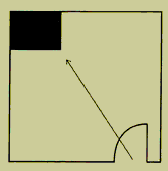
Diagram 9 (a) Showing Jue Chi position with door in the right corner
of room. 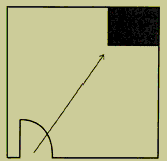
Diagram 9 (b) Showing Jue Chi position with door in the left corner
of room.
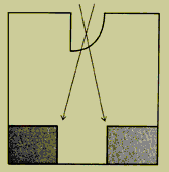
Diagram 9 (c) Showing Jue Chi position with door in the middle of
room.
Area
near the entry doorway usually cannot assemble qi well due to traffic
going in and out of the room. Generally, the wealth position is diagonally
opposite the point of entry. The solid corner of the walls holds the
qi together to assemble wealth for you.
As a general guideline the wealth position in a house should be actuated
in either the living area (where the family gathers together) or in
the study/office where you handle your finances.
Now that we have an idea how the five different schools locate their
wealth position, if you were to apply them to your home, which of
the five methods is most effective?
Different experts have different opinions but they all agree that
to do Feng shui well one must combine the Form analysis with the Compass
orientations so form, space and time can harmonise each other. For
that reason I would use the Luan Tou method (Form) combined with the
Bazhai Space method, followed by the San Yuan and the Feixing (time).
The San He method is also useful since there is normally more than
one person in a house who will bring in an income.
The best approach is to integrate all the methods as much as possible,
using the form (that is, the physicality) of the space to make your
final decision. The sketch below shows the result of one such case.
 This
shows the wealth position in the living area of a typical north facing
unit . The location against the east wall towards the north-east corner
satisfies the Luan Tou, Bazhai and San Yuan methods of analysis. It
will also satisfy the San He combination if the owners zodiac animal
is a pig or a ram. The Feixing (yearly cycle for 2000) reading locates
the wealth postion in the south-east corner of the room where the
corridor runs into the bathroom. so, looking at the physicality of
the space, we can see that this corner is difficult to activate and
should not be considered an option.
In
reality each house or a room has an “outer” wealth position
which can be located according to different feng shui techniques.
However what is more important is the “inner” wealth position
that exists in our own minds. We must bear in mind that feng shui
is no more than a working tool to help us to achieve our goals. When
we have the desire to work hard and spend wisely, it's not so difficult
to become wealthy!



