The Tai Chi is probably the most important concept in Feng Shui. And, nothing makes a well trained Traditional Feng Shui Consultant more irritated than seeing the revered Tai Chi symbol misused.
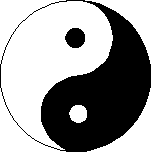
This is the famous T’ai Chi symbol, representing many of the basic ideas of Taoist philosophy, some of which are outlined below. However, one question that often arises is "Which way should one draw the T’ai Chi?"
Taking a look at the wide range of books, magazines, internet sites and other publications, one soon finds a whole host of different orientations of the T’ai Chi, such as those shown here:

So, which is the correct one? Or indeed, is there a correct one ? To understand the answer we must first find out what the T’ai Chi is intended to represent. The following sections outline some of the meanings inherent in the symbol.
Yin and Yang
Yin is the dark, cold, female, introvert, passive side of life, shown as the Black area.
Yang is the light, warm, male, extrovert, active aspect, shown as the White area.
The T’ai Chi symbol means that everything in the Universe (the "Ten Thousand Things" of the Tao Te Ching) contains both light and dark, good and evil. These are complementary aspects rather than conflicting. The two small dots within each area indicate that Yin contains the seed of Yang, and Yang contains the seed of Yin.
The Cycles of Life
Much of Taoist philosophy is based on the idea that everything goes in cycles - the years, the months, the seasons, even human life itself. These cycles are represented by the Circle of the T’ai Chi, and the flow of time is indicated by the way the Yin and the Yang areas increase and decrease as they progress around the symbol.
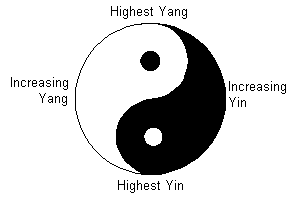
The Seasons
The four seasons - Spring, Summer, Autumn and Winter - are not only part of the Cycles, but are also linked to Yin and Yang.
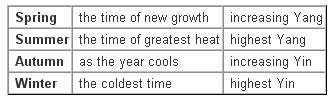
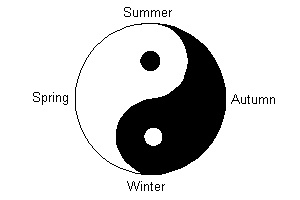
In the T’ai Chi symbol, the seasons are mapped to the appropriate areas of Yin and Yang:
The Chinese Compass Directions.
Like the Western magnetic compass, the Chinese compass is based on the four main directions - North, South, East and West. In Chinese philosophy each direction is linked to a season:
The T’ai Chi symbol is linked to the compass directions, through the seasons:
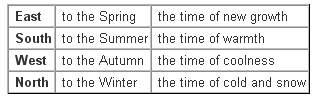
In China the South is considered to be the main direction and is shown at the top of their compasses, unlike in the West where we place North at the top of our maps and compasses.
The T’ai Chi Orientation
If we agree that the T’ai Chi symbol is a representation of all the aspects discussed above - the Yin and Yang, the Cycle of Seasons and the Compass Directions - there is only one ‘Correct’ orientation of the T’ai Chi, being the one used here. Any other orientation may well represent the Yin and the Yang, but does not properly represent the philosophy behind the symbol.
|



