|
|
This is a continuation from the first part of the Eight Immortals. Part 2 tells the stories of He Xiangu, Lan Caihe, Han Xiangzi and Cao Guojiu.
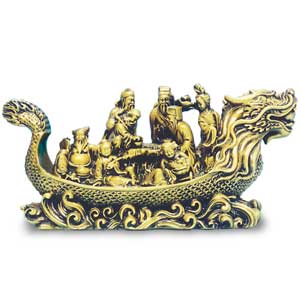
Image courtesy of Dragon-Gate.com
Rose Among Thorns
The only lady in the Eight Immortals, He Xiangu can be recognized with a magic lotus bloom in her hand, sometimes a peach of immortality in the other. She lived in Guangzhou during the reign of Empress Wu Zetian of the Tang Dynsty. Xiangu was said to have been born with 6 strands of golden hair on her head. Although many images portrayed her with a crown of thick flowing hair, some said she never had more than those 6 strands of hair her whole life.
When she was 15 years old, Xiangu dreamt of a deity who told her take some stones and pound them into powder, which she should then consume. This she faithfully did, and found that she could walk at the speed of lightning. She consumed fruits that she found in the mountains and nothing else. One day she found a peach and ate it, and never felt hungry again. (The Chinese believe that the peach is the fruit of immortality.)
Her parents soon arranged a match for her with a good-looking young man in the village. Xiangu did not voice her opinions on the matter but on the wedding day, she was found missing in her bedchambers. She had left a poem on a screen but tried as they did, her parents could not understand the meaning of the poem. She also left behind her favorite pair of soft shoes.
A few years later, a young Taoist priest went to Xiangu's house. He had come down from Luofu Mountain and was instructed by another apprentice named Xiangu to bring her shoes back. It was only then her parents knew that their daughter had been studying Taoism under the famous female Taoist priestess, Magu in Luofu Mountain.
He Xiangu soon became an immortal and was seen by some people floating upon a cloud to Heaven.
The Carefree Immortal
A look at Lan Caihe's portrait would immediately leave one guessing the gender of this immortal. The image of a youth about 16 years old, some said that Lan Caihe was actually a female. According to a book about the Eight Immortals, Lan Caihe was the incarnation of a great deity. Though born a man, he could not understand how to act and behave like what society expects of a man.
Lan Caihe's specialty was the gift of music. His music instruments were usually cymbals and flutes, which he would play along with his self-composed songs. The songs he sang were full of implications on the rulers, state and Mother Earth, but ordinary mortals could not understand them. The verses could only be understood by immortals, who delight in his songs in Heaven. Though beyond their comprehension, old people and children were enchanted by Lan Caihe's songs and could listen to him for hours.
Lan Caihe wore tattered clothes and begged in the city with a wooden bowl. However when given money, he would tie them with a piece of string and wave it around until the money was all scattered, to be picked up by poor people. Though he was brushed off as a mad person, his songs sort of redeemed him in the eyes of the people.
Years went by but they never took their toll on Lan Caihe. His youthful looks remained, even though everyone around him grew old. One day while drinking in a wine shop in the province of Anhui, he heard divine music from Heaven. Almost immediately, a white crane appeared in front of him and flew him into the sky. Lan Caihe then dropped all his clothes onto the ground before disappearing from the eyes of the mesmerized crowd below.
The One Who Saw the Future
The great Han Yu (AD 768 - 824), court official, philosopher and poet was entrusted with the task of guiding his nephew, Han Xiangzi to scholarly heights. The child was intelligent and quickly learnt everything his uncle had to teach. When he was a little older, he met Lu Dongbin (one of the Eight Immortals) and went traveling with him for a while to learn Taoism.
Han Yu was of course not pleased to see his nephew 'gallivanting' around instead of studying hard. When the lad returned home, his uncle admonished him for neglecting his studies. Unperturbed, Han Xiangzi told Han Yu that he had different goals from that of his uncle. He then miraculously made a green peony bloom from a dry stalk. On one of the petals was a poem in gold lettering,
"Clouds envelop Qinling Mountain
I do not know where my home is
The snow covers Lan Kuan Pass
My horse refuses to go on."
Han Yu could not understand the poem but Han Xiangzi told him that all would be clear to him in future. A few years later, Han Yu offended the emperor and was transferred to Chaozhou town in the province of Canton. The journey was difficult as it was winter and the snow was falling thickly. At Lan Kuan Pass, Han Yu saw somebody running up to him - it turned out to be his nephew who swept away the snow for his uncle. Instantly Han Yu thought of the Han Xiangzi's poem a few years earlier. It was only then he understood the young man's prophecy.
Han Xiangzi then comforted his uncle by telling him that this journey would do him good in the end, and he would be returned with his family and be promoted to a higher level. He then left and Han Yu composed a poem using the verse his nephew had given him,
"A memorial presented to His Majesty in the morning
Here I am banished thousands of miles away in the evening
Wanting to assist the wise emperor and rid all evils
I will not bear grudges although this body is old and weak
Clouds envelop Qinling Mountain
I do not know where my home is
The snow covers Lan Kuan Pass
My horse refuses to go on
I know what my nephew means, coming from afar
To claim my bones by the river when I am gone."
Han Xiangzi, already an immortal would occasionally wander on Earth to assist those in need. He is often portrayed with his magical basket of flowers.
Rogue turned Respectable
Of all the Eight Immortals, Cao Guojiu was the last to join the crowd. His background and story were also not ones of virtues and uprightness. Emperor Jen Zhong's (AD 1023 - 1064) wife, the Empress Cao had two younger brothers. The older one Chingxiu, although a court official was not really bothered with his job. The younger one, Chingzhi was irresponsible beyond hope.
One day Chingzhi came upon a couple on the street. The husband, Yuan Wenzheng had come to the capital city with his wife to sit for the imperial examination. Chingzhi was struck by the beauty of the young lady and invited the couple to follow him to the palace. In the palace, Chingzhi strangled Yuan to death and tried to take the wife by force. Although frightened out of her wits, the virtuous lady refused Chingzhi’s advances. Chingzhi then had the lady imprisoned in a dungeon.
Yuan's soul approached the upright Justice Bao and he begged the impartial judge to investigate the case. When Chingxiu heard that Justice Bao had put himself in charge of the case, he advised his younger brother to kill the lady. The latter then ordered the lady be drowned in a well, but a deity later revived her. Having made her escape, she came upon an official, whom she thought was Justice Bao. It turned out to be Chingxiu, who had the woman beaten to death with iron cudgels. She was revived again and promptly went in search for the real Justice Bao. Justice Bao, not fearing the imperial family had Chingzhi put to death and Chingxiu imprisoned.
The empress was saddened by this turn of events and tried hard to save her remaining brother. Her face was always unhappy, and the emperor decided to please her by ordering that all prisoners be set free. Upon Chingxiu's release from prison, he decided to become a hermit and learn Taoism.
One day, Han Zhongli and Lu Dongbin found Chingxiu in a mountain, deep in concentration. After a while they asked him a few questions, which he answered to their satisfaction. They decided to give him a guide to immortality, and it took Chungxiu only a couple of days to claim his place in the Eight Immortals. He was renamed Cao Guokiu and carried a 'weapon' of a tablet which inscribed his admission to the imperial court.
The Eight Immortals Cross the Sea
One day the Eight Immortals attended a Peach Party in Heaven. On their way back, another deity suggested that the Eight Immortals exhibit the power of their magic treasures by using them to cross the sea.
Li Tieguai used his iron crutch, Zhongli Quan used his feather fan, Zhang Guo used his paper donkey, Lu Dongbin his mighty sword, He Xiangu her lotus flower, Lan Caihe his flute and cymbals, Han Xiangzi his basket of flowers and Cao Guojiu his tablet of admission.
The Dragon Prince of the Eastern Sea saw the eight immortals crossing over his abode, and took a liking to Lan Caihe's musical instruments. He decided to obtain them through underhand methods. After a fierce and furious battle, the Dragon Prince and his troops were utterly defeated by the Eight Immortals. This discord went on for a long time, until the Bodhisattva of Compassion, Guan Yin Pu'sa intervened and brought peace in the heavenly realms.
Click here to read Part 1.
|
|
 |
|
|
|
|
|
| This article is brought to you by |
![Suan Tew]() |
Suan Tew
Managing Editor for Feng Shui Times. |
|
|
|
|
|
|
|
|
|
|
|
|
|