 |
Nine
Star Ki Astrology
by Anthea Appel
18/12/2000

Legend
tells us that around the year 2205 BC, a man named Yu of Hsia,
watched a noble Tortoise emerge from the legendary Yellow
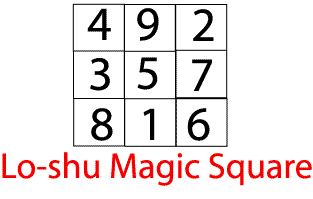
River, carrying on its huge back, nine numbers that were arranged
in a grid pattern. This pattern became to be known as the
Lo-shu and is the predecessor of the Later Heaven pakua. Nine
hundred years earlier, the shaman king Fu Hsi, described the
Earlier Heaven pakua, which appeared to him on the back of
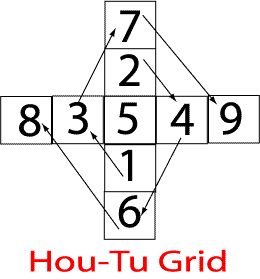
a horse that emerged from the same Yellow River. This pattern
was called the Ho-tu and to understand its meaning, is to
understand the structure of the Universe. But, it is the Lo-shu
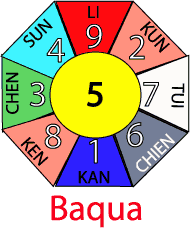
that we see incorporated in the bagua, or pakua, the kua system,
the Eight Aspirations and the Flying Star method. Where the
Ho-tu pakua describes the order of things, the Lo-shu predicts
the changes of Heaven and Earth, the cycles of the seasons,
and the wind and the water.
Figure
#1
What
I’m going to talk about is the 9 Star Ki Astrology, which
is a Japanese system of divination based on the Chinese Lo-shu
(In China, its referred to as White & Purple Star Astrology).
It is an astrological system that uses your birthdate to determine
your personality, emotional character and outward behavior.
This system does not determine your individual element or
auspicious direction. If you want to know your element, then
I will direct you towards Four Pillar of Destiny Astrology—a
whole different ball game. Or, if you’re looking to find the
‘right’ direction to point your head while sleeping, I believe
you’ll find that in the kua system. However, 9 Star Ki does
have something called the Ki-energy of Direction of Movement,
and that tells us, if you travel in a direction that is deemed
unfavorable for your Principal number for that particular
time period, it could prove unlucky. But, let’s worry about
that at some other time.
Take
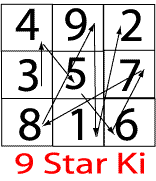
a look at the 9 Star Ki square that’s illustrated above. It’s
important to memorize the movement from one box to the next.
It looks like a puzzle, doesn’t it? I’m going to assume you
have some knowledge of the baqua and the Five Elements. If
you do, this will help. Here’s a way to help you memorize
the puzzle. We start at 3. Why? Because, that’s Chen on the
baqua and that represents ‘young wood’, early spring. In other
words: New Beginnings. Then, move to Hsun (4), ‘mature wood’.
From there, it’s the Tai chi (5), to Chyan (6), to Dui (7),
to Ken (8), to Li (9), to Kan (1) and then to Kun (2), the
trigram that represents Mother on the baqua, which is nourishment.
This is the movement of chi by the second, by the minute,
by the hour, by the day and by the year. It always starts
at Chen and ends at Kun, the place we stop to nourish ourselves
before starting again.
Next
|
|


