 |
Colors
of Feng Shui
....Authentic
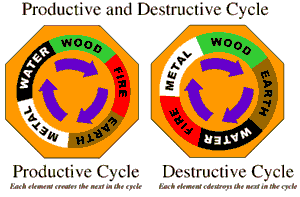
Feng Shui practitioners make use of the fundamental principal
of the 5 Element theory to create productive cycles, weakening
cycles and destructive cycles. (See diagram below.
De Nobrega adds, "Colours can also be categorised by their
element, which enables the Feng Shui practitioner to create
the desired cycle. For instance, the colours brown and yellow
are Earth element colours; white, gold, silver, brass and
copper are Metal element colours; black and blue are Water
element colours; Green is a Wood element colour; red and purple
are Fire element colours. Cream is usually a "neutral" colour,
but its element can sometimes be determined by checking the
"undertone" e.g. yellowish/cream or beige-brown/cream. Grey,
by its very name, can also fall into more than one category:
a white-grey would be considered a Metal colour, while a dark
or blue-grey would be considered a Water element colour."
The Colours Of The Luo Shu
The
Luo Shu (used in the Flying Stars method), which is depicted
below, can also be represented with colours:
- White
is situated in the North
- Black
is situated in the South West
-
Jade is situated in the East
- Green
is situated in the South East
- Yellow
is situated in the centre
- White
is situated in the North West
- Red
is situated in the West
- White
is situated in the North East
-
Purple is situated in the South
Colour
And The Flying Stars
De
Nobrega advises, "One of the best ways to use colour effectively
in Authentic Feng Shui is when assessing the influence of
the Annual Flying Stars. As these energies are weaker than
the Natal energies of a building, they are easier to remedy
or enhance. For example, when the 5 Yellow flies into the
North for the year 2000, one of the ways its negative Earth
element can be mitigated or weakened, is by using Metal colours
such as White, Gold or Silver, which also serve to increase
or grow the water element of the North."
She continues, "Similarly, Metal element colours can be used
to reduce the negative Earth energy of the 2 Black, which
is located in the West this year. The West is also a Metal
element and will therefore not be adversely effected by the
addition of more metal."
Positive
energies can be enhanced using the productive cycle. "Use
Earthy colours to enhance the Annual 7 star, Fire colours
to enhance the Annual 8 Star, and Wood colours to enhance
the Annual 9," she states, "With a little careful thought,
the colours can be used on moveable items such as plant pots,
loose carpets, lamps and scatter cushions, which then easily
become effective remedies that can be moved around from year
to year, as the position of the stars change."
How
To Use Colour
 "From
the above explanations, its easier to understand how colour
has permeated many aspects of Feng Shui," de Nobrega states,
"However, you must not confuse the symbolism and cultural
use of colour in Chinese Society with its correct use in Feng
Shui. As a former decorator, I am well aware of how colour
can change the mood of a room: use it carefully and tastefully
and you can create an environment that is desirable for both
the owner and any visitors Ð you donÕt need to do a Feng Shui
course to achieve this. In my experience as both a decorator
and a Feng Shui practitioner, I've learned that by combining
good dŽcor sense with good Feng Shui sense, you can effectively
achieve a very well balanced environment."
Guidelines
To Implementing Colour To Achieve Good Feng Shui
For
those people who have not had a Feng Shui practitioner audit
their homes, De Nobrega has provided the following guidelines
to help you choose a colour for your rooms:
- The
general idea when using colour is to create a balanced and
harmonious effect that will be aesthetically pleasing. You
do not have to give up on your design principles or good
taste to have good Feng Shui. Nor do you have to paint each
wall in a room a different colour to balance the elements
and create a productive environment.
- The
use of colour to correct Sha Chi (negative energy) or to
improve Sheng Chi (positive energy) is usually not very
powerful. The exception to this rule is the colour red,
or fire colours (red/orange tones). It is better to use
other Feng Shui methods in situations where you have serious
instances of Sha Chi.
 If
the room is dark it will have a predominantly Yin nature:
balance such a room by introducing white, sunny yellow or
some fun, bright colours that have a Yang nature. Using
well-placed lamps and lights will also help, since overly
Yin rooms create a feeling of depression, moodiness and
lethargy.
- If
the room is too bright or Yang, the use of soft colours
and darker shades will go a long way to improving the balance.
Overly bright rooms cause you to suffer from headaches and
aggression.
- Most
colours can be used quite freely without having a profound
effect on your Feng Shui. Once again, Fire colours such
as red should be avoided unless you are certain of the kind
of energy in your room.
- Also,
avoid the use of any Fire colour in your North sector from
now until 5 February 2001 since the north is currently affected
by the 5 Yellow Flying Star (calculated through Chinese
astronomy) which has an Earth element. Following the principle
of the weakening cycle, practitioners try to negate this
ill effect by using Metal or Metal colours. It is much more
effective to use the mythical Pey You or Quirin made of
Brass or other authentic Chinese Feng Shui cures to weaken
its effect, though.
Back
Page
| Next Page
|
|


